 Image: IBM Research, Wikimedia Commons, CC BY 2.0
What a qubit is
The word was coined in 1995 by Benjamin Schumacher, in a paper on compressing quantum information, as a contraction of quantum bit. It names the simplest quantum system there is, one with two distinguishable states, and the whole of quantum computing is built from it. A qubit is easy to define and easy to misdescribe, so here is the definition first.
Two amplitudes
A classical bit is in one of two states, 0 or 1. A qubit has two states too, written \(|0\rangle\) and \(|1\rangle\), but it can also be in any superposition of them,
\[ |\psi\rangle = \alpha\,|0\rangle + \beta\,|1\rangle, \qquad |\alpha|^2 + |\beta|^2 = 1, \]where \(\alpha\) and \(\beta\) are complex numbers called amplitudes. The condition that the squares of their magnitudes add to one is there because those squares are probabilities. Measure the qubit, and you get 0 with probability \(|\alpha|^2\) and 1 with probability \(|\beta|^2\). After the measurement the qubit is in whichever state you found, and the amplitudes are gone.
Two complex numbers are four real numbers. The normalization removes one, and an overall phase common to both amplitudes has no observable effect and removes another. Two real parameters remain, and they can be drawn as a point on the surface of a sphere, the Bloch sphere, with \(|0\rangle\) at the north pole, \(|1\rangle\) at the south pole, and equal superpositions around the equator. The position around the equator is the relative phase between \(\alpha\) and \(\beta\), and it is the part of a qubit that has no classical counterpart at all. Two qubits with the same probabilities for 0 and 1 but different phases are different states, and a quantum computer's operations act on the phase as much as on the probabilities.
What a qubit is not
A qubit is not 0 and 1 at the same time, if that phrase is meant literally. It is not a bit whose value is unknown, either; a coin under a cup is 0 or 1 with some probability, and probabilities alone have no phase and cannot interfere. A qubit on the equator of the Bloch sphere, measured in the 0 and 1 basis, gives a random answer. Measured in a different basis, the one aligned with its position on the sphere, it gives a definite answer every time. The information is all there; it is the choice of question that decides how much of it comes out.
Nor does a qubit store more than one bit of retrievable information. However carefully the amplitudes were prepared, a measurement yields a single 0 or 1, and a theorem by Alexander Holevo from 1973 shows that no scheme of measurement extracts more than one bit from one qubit. The continuous parameters are real, and they matter for what the computer does in between, but you cannot read them out.
Why many qubits are different
Two classical bits have four possible values. Two qubits have four basis states, \(|00\rangle\), \(|01\rangle\), \(|10\rangle\), and \(|11\rangle\), and a general state is a superposition of all four with four amplitudes. Three qubits need eight amplitudes, and \(n\) qubits need \(2^n\). For 50 qubits that is about \(10^{15}\) complex numbers. Written as ordinary double-precision numbers, the state takes about 18 petabytes, more than the memory of any computer in existence, and every additional qubit doubles it. A device with 300 qubits has a state with more amplitudes than there are atoms in the observable universe.
This is the origin of the power of quantum computing and also the origin of its difficulty. Most of those amplitudes belong to entangled states, in which no qubit has a state of its own and the information is held in the correlations. A quantum algorithm arranges operations so that the amplitudes of wrong answers cancel and the amplitudes of right answers add, and then measures, getting one answer out of the whole. Designing operations that do this for useful problems is hard, and only a handful are known.
What qubits are made of
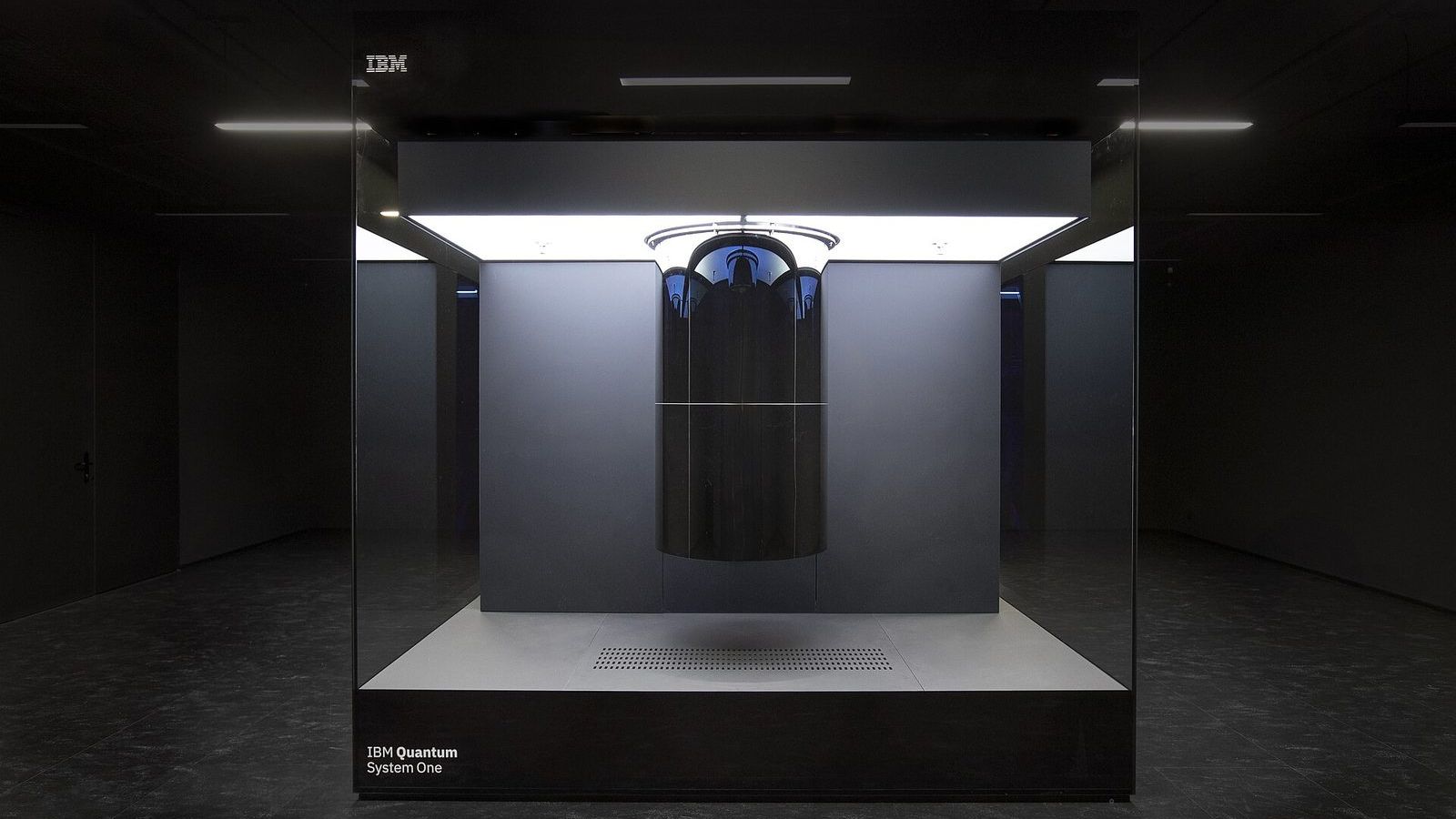
Any quantum system with two states that can be addressed and kept isolated will do, and several are in use. Superconducting circuits, cooled to about 15 millikelvin, in which the two lowest energy states of an oscillating current serve as 0 and 1; these are the qubits of IBM and Google, and the machine in the picture above is one of IBM's. Single ions held in a vacuum by electric fields, with two energy levels of the ion as the states, manipulated with lasers; these hold the records for precision. Neutral atoms held in arrays of laser tweezers, now arranged in grids of hundreds and thousands. Photons, with polarization or path as the two states. Spins of electrons or nuclei in silicon or in diamond.
Each has strengths. Superconducting qubits are fast and are made by the methods of the chip industry. Ions and atoms are identical by nature and keep their states for seconds. Photons travel. None of them is yet good enough on its own, because every qubit loses its state to its environment within a time that ranges from microseconds to seconds, and every operation on it has an error rate between a tenth of a percent and a percent. John Preskill, who coined the phrase noisy intermediate-scale quantum for the present period, set out in a paper in 2018 what such machines might do and what they will not do until the errors are corrected.
Where the qubit came from
The electron's spin, with its two outcomes along any axis, was the first qubit, measured by Stern and Gerlach in 1922 before anyone knew what it was. The polarization of a photon was the second. The mathematics of a two-level system, the Pauli matrices and the Bloch sphere, was complete by 1930, and what changed in the 1980s and 1990s was the realization, by Paul Benioff, Richard Feynman, David Deutsch, and others, that two-level systems could be made to compute and that a computer built from them would not be simulable by a classical one.
In the Quantum Mechanics Masterclass the qubit is introduced in Unit 13, which builds on the spin of Unit 11 and the Dirac notation of Unit 9, defines the single-qubit and two-qubit gates as matrices, and ends with the Bell state. The algorithms that use the \(2^n\) amplitudes follow in Unit 15, and the hardware above, with its error rates and what is done about them, in Unit 16. For those interested in the study routes into the field, the quantum computing pathway page lists them.