 Image: Christian Ursilva, Wikimedia Commons, CC BY-SA 4.0
The Nobel Prize for a circuit you can hold in your hand
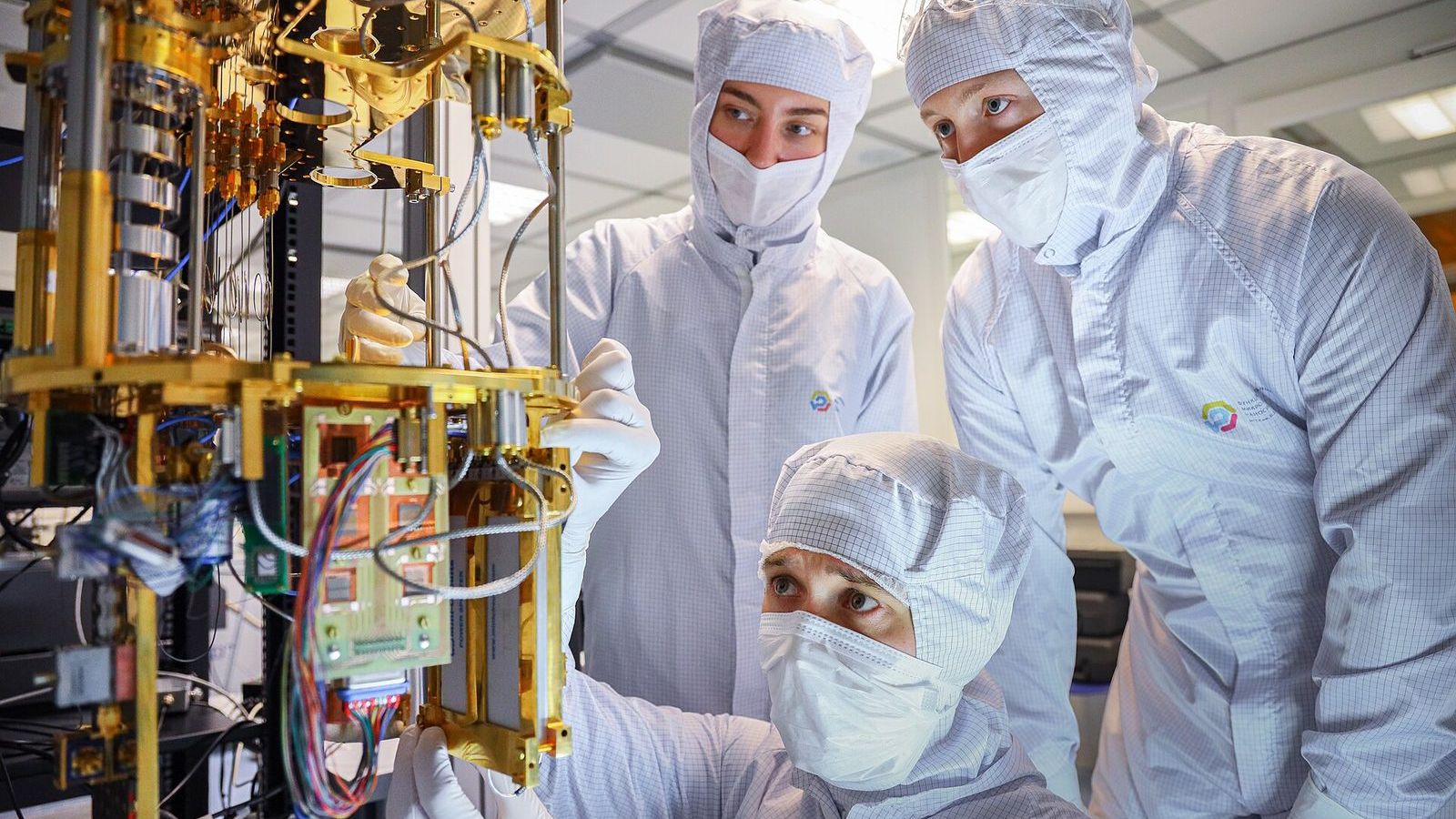
On 7 October 2025 the Royal Swedish Academy of Sciences awarded the Nobel Prize in Physics to John Clarke, Michel Devoret, and John Martinis "for the discovery of macroscopic quantum mechanical tunnelling and energy quantisation in an electric circuit". The experiments were done forty years earlier, in 1984 and 1985, in Clarke's laboratory at the University of California, Berkeley, where Devoret was a postdoctoral researcher and Martinis a graduate student. The object they studied was a superconducting circuit about a centimetre across, cooled to a hundredth of a degree above absolute zero. The question was whether something that large could behave like an atom.
The question
Quantum mechanics was built for electrons and atoms. Tunnelling, superposition, and discrete energy levels were things that single particles did, and the common assumption through most of the twentieth century was that objects made of enormous numbers of particles would lose these properties and behave classically, for reasons that were not entirely clear. The physicist Anthony Leggett argued around 1980 that this assumption could be tested, and proposed a specific system in which a variable describing the collective motion of billions of electrons might tunnel.
The system was a Josephson junction: two superconductors separated by a thin insulating layer, through which pairs of electrons tunnel without resistance. The current through the junction depends on the difference between the quantum phases of the two superconductors, and that phase difference is a single variable that describes the whole circuit at once. Brian Josephson had predicted the effect in 1962 at the age of 22 and received the Nobel Prize in 1973. The new question was whether the phase itself, a property of the macroscopic circuit, obeyed quantum mechanics.
The experiments
The phase of a current-biased junction behaves like a particle in a tilted washboard potential, a series of wells separated by barriers. With no current flowing across it, the phase sits in a well. Classically it stays there until thermal agitation kicks it over the barrier, after which a voltage appears across the junction. The escape rate should fall steeply as the temperature drops and vanish at absolute zero.
Devoret, Martinis, and Clarke measured the escape rate down to about 20 millikelvin and found that it stopped falling. Below a certain temperature the phase escaped at a rate independent of temperature, which is what tunnelling through the barrier predicts and thermal activation forbids. The rate matched the quantum prediction once the damping of the circuit was taken into account, which had been the main doubt. The circuit, with its billions of electrons, was tunnelling as a single quantum object.
The second experiment was the more striking. If the phase is a quantum particle in a well, its energy in the well should come in discrete levels, like those of an atom. The team shone microwaves on the junction and found that the escape rate rose sharply at particular frequencies, the frequencies at which a microwave photon matched the spacing between two levels. The levels were there, unevenly spaced as the shape of the well required, and their positions agreed with the Schrödinger equation applied to the circuit. The two papers appeared in Physical Review Letters in 1985 and are summarized, with the figures, in the Nobel committee's popular account.
Why it was more than a confirmation
The result closed a question about the scope of quantum mechanics: there is no size at which the theory stops applying, provided the object is cold enough and isolated enough. More important for what followed, it showed that a circuit made with the tools of the semiconductor industry could be an artificial atom, with energy levels that engineers could design by choosing the capacitance and the junction, and could tune by applying a current.
An artificial atom with two addressable levels is a qubit. In 1999 Yasunobu Nakamura and colleagues at NEC in Japan showed coherent oscillations between two states of a superconducting circuit, the first superconducting qubit, which held its state for a few nanoseconds. In 2007 a group at Yale, where Devoret had moved, invented the transmon, a variant that is insensitive to charge noise, and its coherence time has since risen from microseconds to hundreds of microseconds. Transmons are the qubits of the processors built by IBM and by Google, where Martinis led the team that built the Sycamore chip of 2019 and Devoret later became chief scientist for quantum hardware. The circuit on which the prize was awarded is, in a direct line, the circuit in those machines.
The laureates
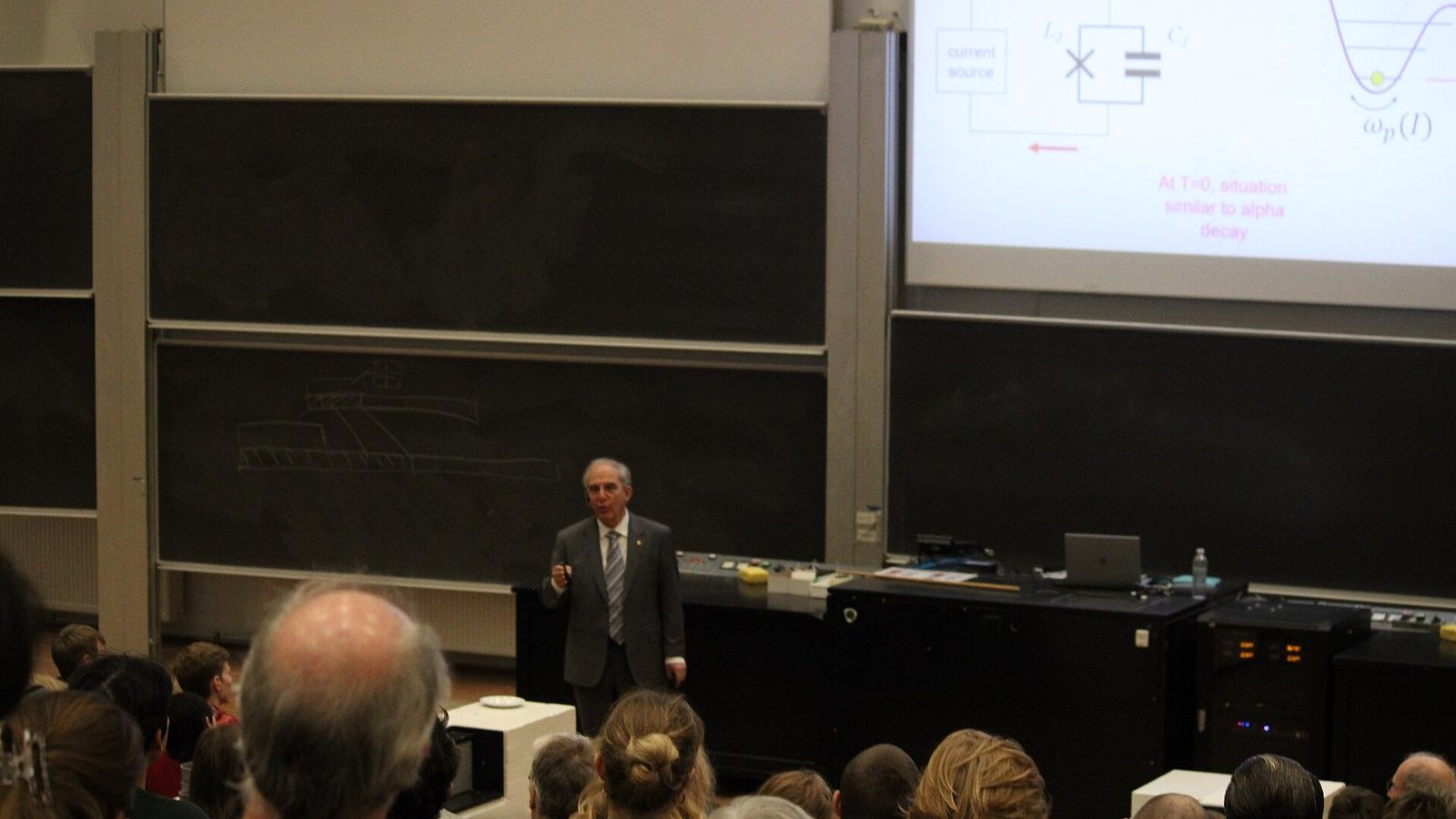
John Clarke, born in Cambridge in 1942, has spent his career at Berkeley, where he developed superconducting quantum interference devices, SQUIDs, into the most sensitive magnetometers in existence, used in geophysics, in medicine, and in searches for dark matter. Michel Devoret, born in Paris in 1953, moved from Berkeley to the French atomic energy commission at Saclay, founded the quantronics group there, and in 2002 joined Yale; he is now at the University of California, Santa Barbara, as well. John Martinis, born in 1958, was a professor at Santa Barbara, led Google's quantum hardware effort from 2014 to 2020, and has since founded a company to build superconducting processors.
Clarke said at the announcement that the prize was "the surprise of my life", and that in 1985 none of the three had imagined the work would lead to computers. The prize of 2025 is unusual in rewarding a result that sits at the boundary between a test of fundamental physics and the start of a technology, and in the forty years it took for the second half of that sentence to become clear.
In the Quantum Mechanics Masterclass, tunnelling is derived in Unit 5, the quantized levels of a particle in a well are the subject of the same unit and of Unit 10, and the transmon, the hardware built from it, and the prize of 2025 are presented in Unit 16, together with the research of Devoret's group on error correction in superconducting cavities. The full list of units is in the curriculum.