Quantum Mechanics Masterclass 12-Week Online Program with Certificate

One unit per week on the photon, the wave function, the atom, and entanglement, with every derivation written out step by step.

  • Certificate
  • Online
  • Join a community of 4000+
s l = 0 p l = 1 d l = 2 f l = 3 n = 1 n = 2 n = 3 n = 4

3d

n = 3, l = 2, m = 0

0 radial nodes, 2 angular nodes

Energy level E3 = −1.51 eV

The orbitals of hydrogen, computed in your browser from . Each panel is a slice through the nucleus along the z axis, drawn to its own scale; depth of colour follows , and blue and coral mark the two signs of . Select an orbital to see its quantum numbers and energy, .
ionized0 eVn = 1−13.60 eVn = 2−3.40 eVn = 3−1.51 eVn = 4−0.85 eVLyman line, 121.6 nmultraviolet, 10.2 eV656.3486.1434.0410.2Balmer lines, nm (visible)400 nm500 nm600 nm700 nm
The energy levels of hydrogen on a true scale. An electron that drops from n = 3 to n = 2 emits a photon of , the red line at 656.3 nm; the drops from 4, 5, and 6 give the blue and violet lines. Unit 7 derives them.

Twelve weeks in the quantum world

The QM Masterclass takes you through quantum mechanics one unit at a time. You enrol, and from then on a new unit reaches you every week. Each unit is a chapter written for this program, with complete derivations, worked examples, interactive figures, and the published research of physicists who are active today.

A quiz completes every unit and opens the next. At the end you sit a final exam and receive a certificate with a public verification page.

  • Structured. A fixed sequence of units that begins with complex numbers and waves and ends at research that is still under way.
  • Demanding and fair. Real physics with real mathematics, and every derivation written out in steps you can check with pencil and paper.
  • Recognized. A certificate and a transcript, both with a verification ID that anyone can check online.
How the program works

Who is this program for?

For high school students, university students, and lifelong learners. You need no previous knowledge of quantum physics: Unit 1 gives every participant the same mathematical toolkit.

High School Students

You have met photons and energy levels in your physics lessons and want the theory behind them. The masterclass prepares you for university applications and for competitions such as the International Physics Olympiad (IPhO), the European Physics Olympiad (EuPhO), the Asian Physics Olympiad (APhO), and your national olympiad.

  • School mathematics is enough
  • Certificate for applications
  • Derivations written out in full

University Students

A companion to your degree in physics, chemistry, engineering, or computer science. Use it to prepare for a quantum mechanics course, a first project in quantum computing, or competitions such as PLANCKS and quantum hackathons like MIT's iQuHACK.

  • Full derivations and worked examples
  • Current research papers
  • A base for a first project

Lifelong Learners

You have read about Schrödinger's cat or about quantum computers in the news and want to understand the physics behind the headlines. Or you studied science long ago and want to see what the wave function actually says. The masterclass goes step by step, at your pace.

  • No deadlines, pause any time
  • Unit 1 refreshes the mathematics
  • Read on screen or as PDF

How does it work?

Six steps take you from your enrolment to your certificate.

  1. Enrol

    Create your account with your email address, choose your masterclass, and pay the Tuition Fee. Your program starts at once.

  2. Receive your unit

    Unit 1 arrives immediately and every further unit on a Monday, as a web page and as a PDF to keep.

  3. Study

    Work through the derivations, the worked examples, and the interactive figures, and answer the questions in the text as you go. A day later we send further reading, including research papers that are free to read.

  4. Take a quiz for every unit

    Each unit has its own quiz: ten questions, open book, no time limit. You submit it before the next unit is sent to you.

  5. Sit the final exam

    50 questions across the units of your masterclass in 60 minutes, open book. You pass with 70% and have up to 3 attempts.

  6. Earn your certificate

    Certificate and transcript as PDF, each with a verification ID and a personal link you can share.

The program in detail

Topics

Sixteen units in three groups. Foundation covers the first eight, Advanced the first twelve, and Advanced + Quantum Information all sixteen.

2s orbital

Units 1 to 8

The Quantum World

Why light comes in photons and electrons behave as waves, what the wave function describes, how particles tunnel through barriers, why a measurement has a limited precision, and how the hydrogen atom gets its lines, with a closing unit on entanglement and the meaning of the theory.

The Schrödinger equation
  1. Complex Numbers, Waves, and Probability
  2. The Quantum of Light
  3. Matter Waves and the Double Slit
  4. The Wave Function and the Schrödinger Equation
  5. Wells, Barriers, and Tunnelling
  6. Operators, Measurement, and Uncertainty
  7. The Hydrogen Atom
  8. Entanglement and the Meaning of Quantum Mechanics
All 16 units with their summaries
  1. Complex Numbers, Waves, and ProbabilityQuantum mechanics describes an electron by a complex number at every point in space, whose modulus squared is a probability and whose phase makes electrons interfere. This unit builds that toolkit from school mathematics: complex numbers and Euler's formula, the mathematics of waves and wave packets, probability distributions and the Gaussian, and the derivative and the integral as tools. It ends with the energies, sizes, and time scales of the atomic world and the timeline of the discovery of quantum mechanics.
  2. The Quantum of LightIn 1900 Planck could only fit the glow of a hot body by letting energy come in portions of size hf, and within a quarter of a century these portions had become particles. This unit derives Planck's radiation law from the quantum hypothesis, explains the photoelectric effect with Einstein's equation and Millikan's measurements, computes the energy and momentum of a photon, and shows in Compton's experiment that a photon collides with an electron like a particle. It ends with the Paris experiment that counts the photons in a box without absorbing them.
  3. Matter Waves and the Double SlitIn 1924 de Broglie proposed that every moving particle has a wavelength, and within three years electrons had been diffracted by a crystal. This unit computes the wavelengths of electrons, neutrons, atoms, molecules, and a tennis ball, explains the Davisson-Germer experiment and the double slit, shows how single electrons build up an interference pattern dot by dot, and states what happens when the path of a particle is recorded. It ends with interfering molecules of 10,000 atomic mass units and the electron microscope.
  4. The Wave Function and the Schrödinger EquationThe wave that built up the fringes of Unit 3 gets its name and its rules. This unit explains what the wave function is and what it is not, how Born's rule turns it into probabilities, how a free particle looks as a plane wave and as a spreading wave packet, where the Schrödinger equation comes from and why it contains the imaginary unit, what a stationary state is, and why a superposition of two energies beats at the frequency of the light an atom emits. It ends with the first three postulates of quantum mechanics.
  5. Wells, Barriers, and TunnellingThe Schrödinger equation is solved for the simplest traps there are, a box with hard walls, a well with soft walls, a step, and a barrier. A confined particle may have only certain energies and never zero energy, its wave function leaks into regions a classical particle could never enter, and a particle passes through a wall it lacks the energy to climb. This unit works out the numbers for electrons, marbles, and nuclei, and follows tunnelling into the scanning tunnelling microscope, alpha decay, flash memory, the Sun, and the colours of quantum dots.
  6. Operators, Measurement, and UncertaintyA laboratory measures energies and momenta, not only positions, and this unit says how the wave function predicts them. Observables become operators, the possible results of a measurement are their eigenvalues, and two postulates fix the probabilities and the state that a measurement leaves behind. The unit computes averages and spreads from the wave function, states the Heisenberg uncertainty relation in its precise form and checks it on the particle in a box and the Gaussian packet, explains why atoms do not collapse and why spectral lines have a width, and separates what the relation says from what it does not.
  7. The Hydrogen AtomHydrogen is the one atom whose Schrödinger equation can be solved exactly, and its sharp spectral lines have tested quantum theory for a century. This unit follows the road from Balmer's formula and Bohr's orbits to the quantum numbers n, l, and m, the radial probability density that replaces the orbit, the shapes of the s, p, and d orbitals, and the selection rules behind the lines. It ends with the fine structure, the Lamb shift, and the 1S-2S transition frequency measured to fifteen digits.
  8. Entanglement and the Meaning of Quantum MechanicsEinstein argued that quantum mechanics is incomplete and Bohr that the question was meaningless, until John Bell showed in 1964 that the dispute could be settled by counting photons. This unit works out the correlations of two entangled photons, proves a Bell inequality by counting, computes how quantum mechanics breaks it, and follows the experiments from 1972 to the loophole-free tests of 2015. It then explains why no cat is ever seen in two states at once, compares the main interpretations of the theory, and places eight units of quantum mechanics in the sciences and technologies built on them.
  9. Dirac Notation and Hilbert SpaceThe first Advanced unit rebuilds quantum mechanics in the language physicists actually use. A state becomes a vector written as a ket, an observable becomes a Hermitian matrix, a measurement becomes a projection, and the five postulates that Units 4 and 6 stated for wave functions fit into one box. The commutator of two observables gives the general uncertainty relation, the time evolution operator turns the two lowest states of the ammonia molecule into a clock ticking at 23.87 GHz, and the wave functions of the earlier units turn out to be the components of a ket in the basis of position states.
  10. The Harmonic Oscillator and Ladder OperatorsAlmost every bound system behaves as a harmonic oscillator near its equilibrium, which makes the oscillator the most used model of quantum mechanics. This unit solves it twice, once by guessing the Gaussian ground state and once with the raising and lowering operators that give the whole ladder of levels in a page of algebra. The equally spaced levels, the zero-point energy, and the matrix elements then explain the infrared spectra of molecules, the heat capacity of solids, the photon as the quantum of a field mode, and how a glass sphere of a hundred million atoms was cooled to its motional ground state.
  11. Angular Momentum and SpinThree commutation relations fix which values an angular momentum can take, and they allow a kind of angular momentum that no orbit produces. This unit derives the quantum numbers of Unit 7 from the algebra alone, follows the silver atoms of Stern and Gerlach through their magnet in February 1922, and builds the theory of spin one-half with two-component spinors and the Pauli matrices. It then puts the spin into a magnetic field, where it precesses at the Larmor frequency that magnetic resonance imaging is tuned to, and ends with the singlet and triplet states of two spins and the fine structure of atomic lines.
  12. Identical Particles and the Exclusion PrincipleNo experiment can tell two electrons apart, and quantum mechanics turns this into a rule about the sign of the wave function under exchange. This unit follows that rule to the Pauli exclusion principle, the periodic table and the saw-tooth of the ionization energies, the Fermi gas of electrons in copper and in a white dwarf, and the Bose-Einstein condensate first made from rubidium atoms at 170 nanokelvin in June 1995. Two research spotlights show a Fermi gas that refuses to scatter light and a condensate that stores a pulse of light.
  13. Qubits and Quantum GatesThe first unit of the quantum information masterclass turns the two-level systems of the earlier units into the qubit of a quantum computer. The student writes a qubit as a point on the Bloch sphere, applies the gates X, Y, Z, H, S, T, and CNOT as matrices and as rotations, builds a Bell state from two gates, tests whether a two-qubit state is entangled, and proves that no machine can copy a qubit. The unit ends with the state of the hardware in the NISQ era and with John Preskill's paper that named it.
  14. Bell's Theorem, Teleportation, and Quantum CryptographyThe Bell states and their correlations lead to the CHSH inequality, proved in full with its local bound 2 and its quantum maximum of two root two, and to the three experiments of 2015 that closed the loopholes at once. The unit then turns entanglement into a resource: it runs the teleportation protocol step by step, shows why nothing travels faster than light, and builds the BB84 and E91 protocols for a secret key, ending with the entangled photons that the Micius satellite sent to two stations 1,203 km apart.
  15. Quantum AlgorithmsA quantum computer does not try every answer at once; it arranges the amplitudes of all answers so that the wrong ones cancel. This unit shows three ways of doing that: the Deutsch-Jozsa algorithm, which decides a property of a function with one evaluation, Grover's search, which finds one item among N in about the square root of N steps, and Shor's algorithm, which factors a number by finding a period with the quantum Fourier transform. The number 15 is factored by hand, the cost of breaking a 2,048-bit RSA key is compared with published estimates, and the unit ends with what has actually been factored and why the records are small.
  16. Quantum Error Correction and Quantum HardwareEvery physical qubit forgets within microseconds or seconds, and the algorithms of the previous unit need billions of operations. This unit shows how a logical qubit spread over many physical ones can be protected by measuring only what the errors did, from the three-qubit code to Shor's code and the surface code, and what the threshold theorem promises. It then compares the superconducting, trapped-ion, neutral-atom, silicon, and photonic machines on which this is being tried, including the 2024 result that ran a surface code below threshold.

Full curriculum

Tuition Fee

Choose the masterclass that fits you best. One Tuition Fee, paid once, covers all units, quizzes, the final exam, and your certificate.

8 weeks

Foundation

The fundamentals of quantum mechanics: the photon, the wave function, the atom, and entanglement.

Tuition Fee$35$39
Enrol in Foundation
  • 8 weekly units as web page and PDF
  • Quiz and further reading for every unit
  • Final exam, certificate, and transcript
16 weeks

Advanced + Quantum Information

The full program plus four units on qubits, Bell's theorem, quantum algorithms, and error correction.

Tuition Fee$85$119
Enrol in Advanced + Quantum Information
  • 16 weekly units as web page and PDF
  • Quiz and further reading for every unit
  • Final exam, certificate, and transcript

The Tuition Fee is paid once, online, through Stripe. It is set in US dollars and converted into your currency during the payment. There are no further costs. Financial aid

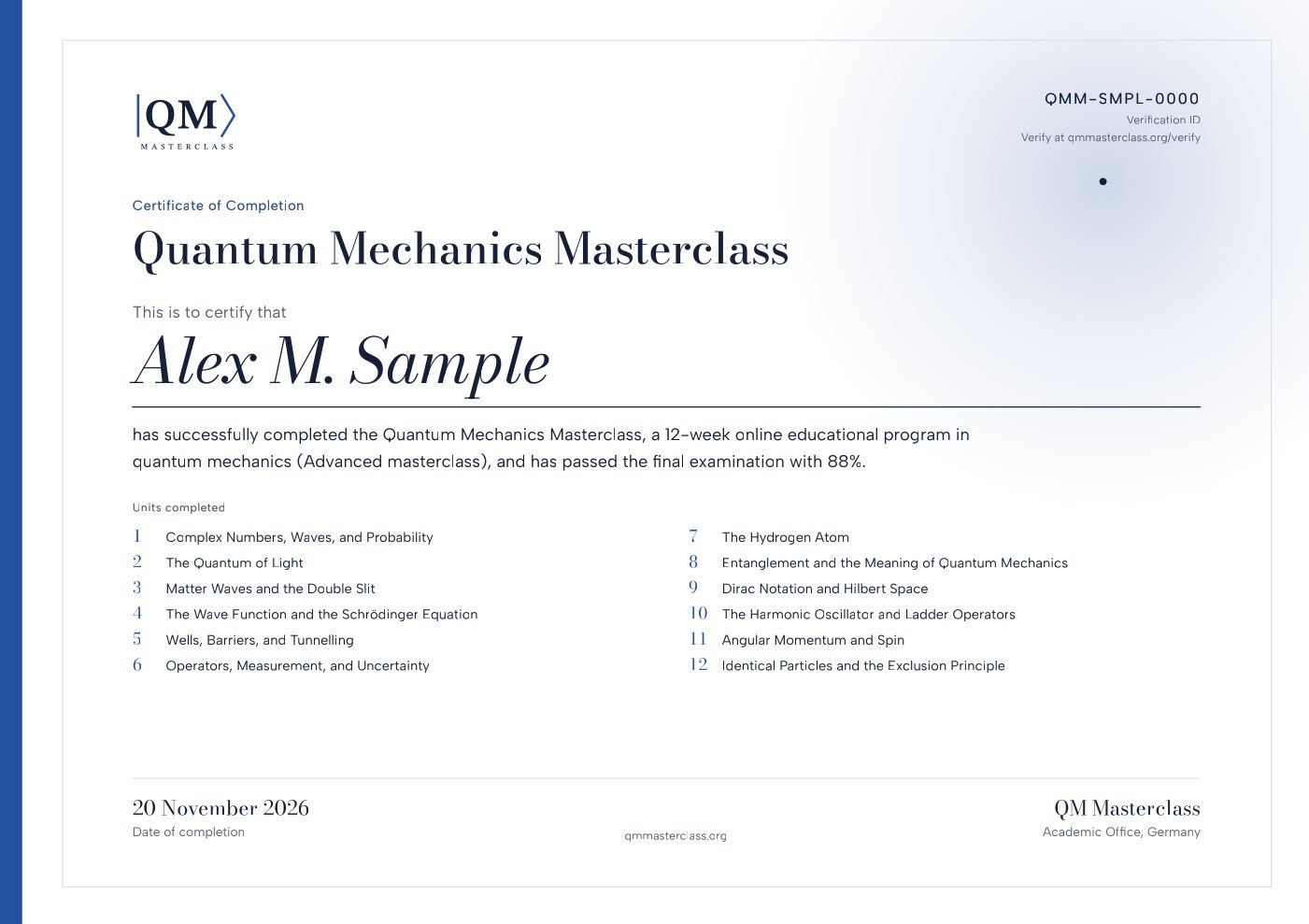
Sample certificate of completion of the Quantum Mechanics Masterclass

Your certificate

Participants who pass the final exam receive an official certificate of completion. It states your name, the masterclass, its duration, and the units you completed.

  • Certificate and transcript. The transcript lists your score in every unit quiz and in the final exam.
  • Verifiable. Both documents carry a verification ID that can be checked on this website.
  • Shareable. Your personal verification link shows your result to universities, scholarship committees, and employers.
First page of Unit 3: Matter Waves and the Double Slit

Sample unit

Read one complete unit before you enrol, exactly as participants receive it: the full text with its worked examples, derivations, figures, and research spotlight.

Unit 3, 14 pages

Matter Waves and the Double Slit

In 1924 de Broglie proposed that every moving particle has a wavelength, and within three years electrons had been diffracted by a crystal. This unit computes the wavelengths of electrons, neutrons, atoms, molecules, and a tennis ball, explains the Davisson-Germer experiment and the double slit, shows how single electrons build up an interference pattern dot by dot, and states what happens when the path of a particle is recorded. It ends with interfering molecules of 10,000 atomic mass units and the electron microscope.

The unit opens with 6 questions

  1. What is the de Broglie wavelength of an electron accelerated through 54 volts, and why is it close to the spacing of atoms in a nickel crystal?
  2. Why do we never notice the wave nature of a tennis ball?
  3. What did Davisson and Germer observe in 1927 when they scattered electrons from a nickel crystal?
  4. How can bright and dark bands appear when electrons pass through a double slit one at a time?
  5. What happens to the pattern when we find out which slit each electron passed through?
  6. Why can a molecule of 10,000 atomic mass units still interfere, and what limits the resolution of an electron microscope?

Academic community

Masterclass participants come from all over the world, and when you complete the program you stay part of a network that keeps you close to physics.

Physics academics in our community
4000+
Countries represented
90+
Schools and universities represented
750+
Twenty-nine physicists in three rows in front of a building in Brussels, among them Planck, Curie, Lorentz, Einstein, Bohr, Heisenberg, Schrödinger, and Dirac.
The fifth Solvay Conference, Brussels, October 1927. Photograph: Benjamin Couprie, Institut International de Physique Solvay; restored scan by Wilfredor, public domain.

QM-Connect

Our alumni program introduces former participants to one another across countries: for study advice, exchange about university applications, and shared projects.

Opportunities

Past participants hear from us about scholarships, competitions, summer schools, and other academic opportunities in physics and quantum technology.

A place in science

The program shows you how research in quantum physics is done and where it happens, so that your next step at school, at university, or beyond is an informed one.

The academic community

Frequently asked questions

Who is this program for?

For high school students, university students, and lifelong learners. High school students use it to get ahead in physics early and to prepare for university applications or for olympiads. University students in physics, chemistry, engineering, or computer science take it next to their degree or before a first project in quantum computing. Lifelong learners use it to find out what the wave function says behind the headlines about Schrödinger's cat and quantum computers. The Foundation masterclass suits a first contact with the subject; the Advanced masterclass goes on to Dirac notation, the harmonic oscillator, spin, and identical particles; Advanced + Quantum Information adds qubits, Bell's theorem, quantum algorithms, and error correction.

What do I need to know before I start? Do I need calculus or linear algebra?

School mathematics is enough: algebra, trigonometry, exponentials and logarithms, and powers of ten. You do not need any previous knowledge of quantum physics. Unit 1 teaches complex numbers, the mathematics of waves, probability distributions, and the derivative and the integral as tools, which every later unit uses. From Unit 4 onwards the text uses derivatives and simple integrals and shows every step; no unit asks you to solve a differential equation from scratch. Unit 9 teaches the vectors and matrices that the Advanced units work with, before they are used.

How much time does a unit take, and are there live sessions?

Most participants spend 3 to 5 hours on a unit, including the quiz. The units on the hydrogen atom, on angular momentum and spin, and on quantum algorithms take longer if you work through every derivation with pencil and paper, which we recommend. The program is fully online and has no live sessions, so it works in every time zone and next to school or work. You receive the units by email on Monday and read them on the website or as PDF; the quizzes and the final exam are taken on the website.

Can I finish the program in less than 12 weeks?

Yes. A new unit is scheduled for every Monday, but once you have submitted the quiz of a unit you can ask for the next one ahead of schedule, from your dashboard or from the email we send you. The earliest moment is 24 hours after the previous unit was sent. We recommend the weekly rhythm, because new ideas in quantum mechanics need time to settle, but the pace is your decision.

What happens if I fall behind or have to pause?

Nothing is lost. The next unit is only sent once you have submitted the quiz of the current one, so the program waits for you. You can pause for a week or for a term and continue at any time. There is no penalty and no deadline.

How does the final exam work?

After the last unit you sit the final exam online: 50 multiple-choice questions across the units of your masterclass, drawn individually for each participant, with a time limit of 60 minutes. It is open book. You pass with 70% correct answers. If you do not pass, you can try again after 3 days with new questions, up to 3 attempts in total.

All questions

Begin your 12 weeks in the quantum world