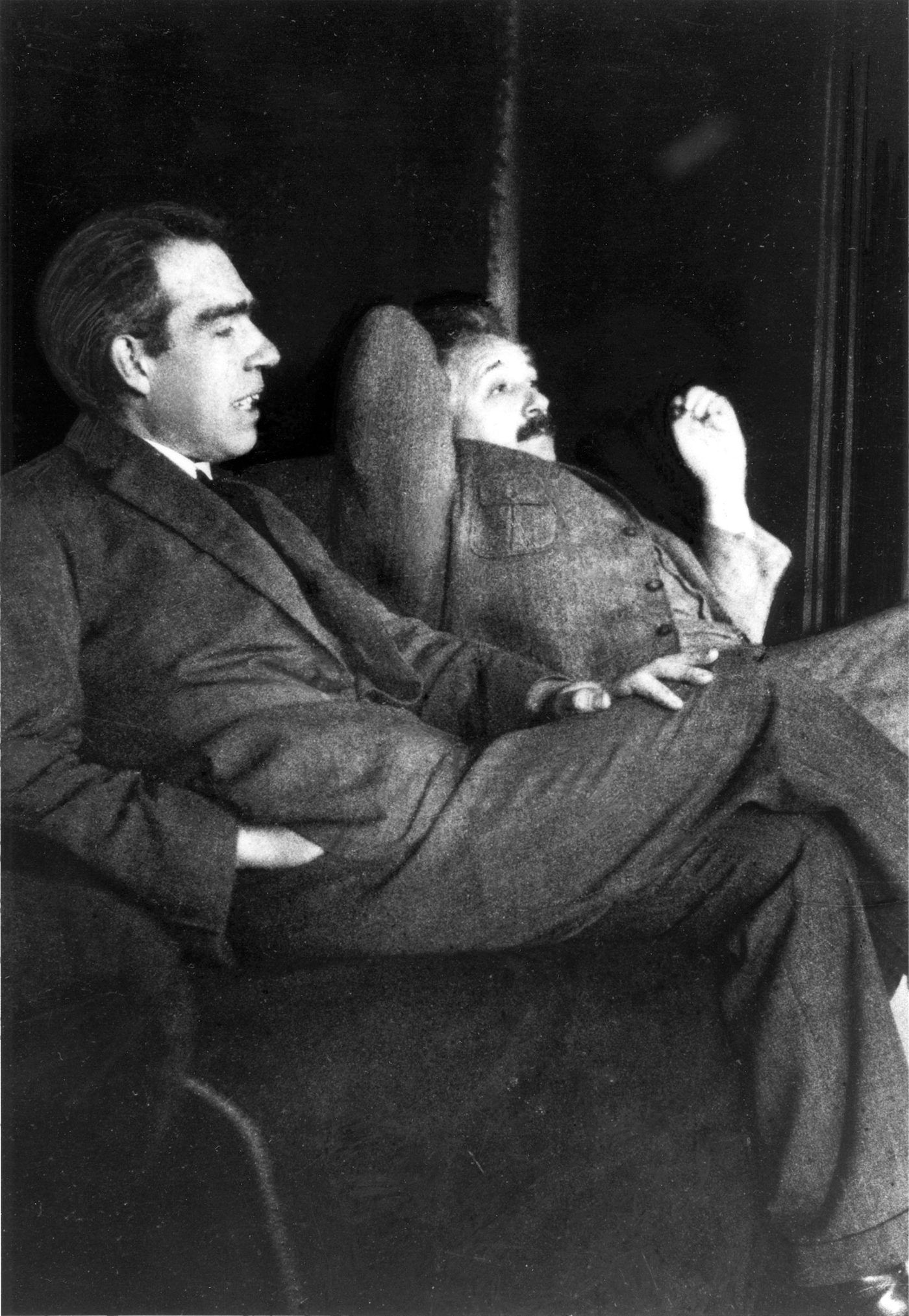
Image: Benjamin Couprie, Institut International de Physique Solvay; public domain, via Wikimedia Commons
Einstein argued that quantum mechanics is incomplete and Bohr that the question was meaningless, until John Bell showed in 1964 that the dispute could be settled by counting photons. This unit works out the correlations of two entangled photons, proves a Bell inequality by counting, computes how quantum mechanics breaks it, and follows the experiments from 1972 to the loophole-free tests of 2015. It then explains why no cat is ever seen in two states at once, compares the main interpretations of the theory, and places eight units of quantum mechanics in the sciences and technologies built on them.
Preview: the beginning of the unit
Unit 4 gave the wave function and the Born rule, Unit 6 added the postulates of measurement, and together they predict every experiment described in this masterclass. What they do not say is what happens during a measurement, and whether the probabilities of the Born rule are, as in a game of dice, only a cover for values that exist but are not known. Einstein believed that they were, and Bohr held that the question had no answer an experiment could give. The dispute remained a matter of taste for thirty years, until John Bell (1928-1990) showed in 1964 that it could be settled by counting photons, and experiments between 1972 and 2015 counted them. This unit follows that story to the measurements that decided it, then asks why nobody has ever seen a cat in two states at once, and ends with what physicists today make of the theory they all use.
1 The Bohr-Einstein debate
Albert Einstein (1879-1955) had done more than anyone to start quantum physics. His paper of 1905 in the journal Annalen der Physik, volume 17, page 132, proposed that light consists of quanta, the photons of Unit 2, and the Nobel Prize in Physics 1921 was awarded for it. Yet when the finished theory arrived in 1926 with probability built into its foundations, he refused to accept that probability was the last word. In December 1926 he wrote to Max Born (1882-1970) that the theory delivered a great deal but brought us hardly closer to the secret of the Old One, his name for God, who, he was convinced, does not play dice.
Niels Bohr (1885-1962) took the opposite view. For him the quantities a physicist talks about, such as position, momentum, and polarization, are defined only together with the apparatus that measures them, which is the complementarity of Unit 3. Asking what the polarization of a photon is before any polarizer has been chosen was, in Bohr’s view, asking a question without content. The two men argued about this for the rest of their lives, with great affection and without either giving way. Figure 1 shows them in Leiden in 1925, two years before the argument became public.
Figure 1. Niels Bohr and Albert Einstein, photographed by Paul Ehrenfest at his home in Leiden in December 1925, most likely during the celebrations of the fiftieth anniversary of Hendrik Lorentz’s doctorate. Credit: Paul Ehrenfest; public domain, via Wikimedia Commons.
1.1 Schrödinger’s cat and the measurement problem
The postulates of Units 4 and 6 contain two different rules for how a state changes. Between measurements the wave function obeys the Schrödinger equation (Postulate 5), which is linear, so that a superposition stays a superposition. At a measurement, by the collapse postulate (Postulate 4), the state jumps to the one outcome that was found, with the probabilities of the Born rule. The theory never says what counts as a measurement. A Geiger counter is made of atoms that obey the Schrödinger equation like any others, so if an atom in a superposition of decayed and not decayed interacts with the counter, linearity forces the counter into a superposition of having clicked and not having clicked. The question of where and why a superposition turns into a single fact is called the measurement problem, and it is still open.
The full unit is part of the program
Want to see a complete unit first? Unit 3, Matter Waves and the Double Slit, is free to read.