 Image: Travis.jennings, Wikimedia Commons, CC BY 3.0
What the colours of quantum dots have to do with a particle in a box
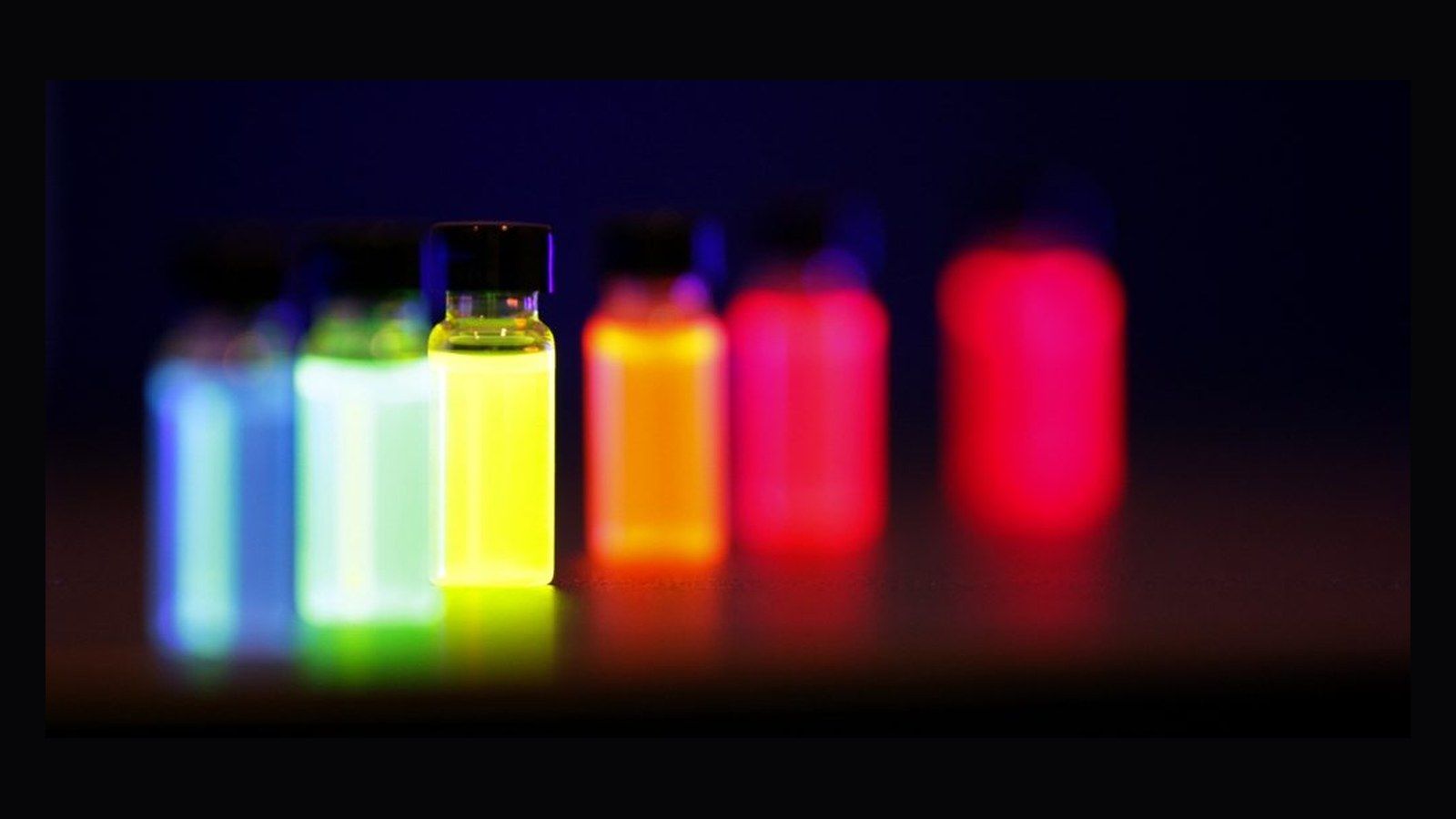
Line up five glass vials of the same substance, cadmium selenide, under an ultraviolet lamp, and they glow blue, green, yellow, orange, and red. Nothing about the chemistry differs from one vial to the next. What differs is the size of the crystals suspended in the liquid: about two nanometres across in the blue vial and about six in the red. The crystals are called quantum dots, and the reason their colour follows their size is the simplest calculation in quantum mechanics.
A particle in a box
Take a particle of mass \(m\) that is free to move inside a region of length \(L\) and cannot leave it. In quantum mechanics the particle is described by a wave, and a wave confined between two walls can only have wavelengths that fit: half a wavelength across the box, or a whole one, or one and a half, like the standing waves on a guitar string. The de Broglie relation turns each allowed wavelength into a momentum and each momentum into a kinetic energy, and the result is a ladder of allowed energies
\[ E_n = \frac{n^2 h^2}{8 m L^2}, \qquad n = 1, 2, 3, \ldots \]Two features of this formula matter here. The lowest energy is not zero; a confined particle always moves. And every energy grows as \(1/L^2\), so halving the box multiplies all the energies by four. A smaller box means larger energy steps.
For an electron in a box one nanometre long, the lowest level is 0.38 eV and the gap to the next one is 1.1 eV. In a box one centimetre long the same gap is \(10^{-14}\) eV, far too small to notice, and the electron behaves classically. Quantum effects of confinement appear when the box is comparable to the de Broglie wavelength of the particle, which for an electron at ordinary energies is a few nanometres.
What is in the box
In a semiconductor crystal an electron that has been excited by light leaves behind a hole, a missing electron that behaves like a positive particle. The electron and the hole together can fall back and emit a photon, and the photon's energy is the band gap of the material plus the confinement energies of the two particles. In a large crystal the confinement energies are negligible and the colour is fixed by the band gap: 1.74 eV for cadmium selenide, which is deep red.
Shrink the crystal to a few nanometres and the electron and the hole are each a particle in a box of that size. Their lowest energies rise as \(1/L^2\), the emitted photon gains that energy, and the light shifts towards the blue. A three-dimensional box, spherical rather than a line, changes the numerical factor but not the scaling, and in a real crystal the masses that enter the formula are effective masses, smaller than the free electron mass, which makes the effect larger. For cadmium selenide the shift takes the emission from 1.74 eV in bulk to about 2.5 eV, blue light, in a crystal two nanometres across. Louis Brus at Bell Laboratories wrote down this account in 1984 and showed that it matched his measurements on crystals grown in solution.
From theory to vials
The first quantum dots were made in coloured glass. Alexei Ekimov, working in Leningrad around 1980, found that the colour of glass containing copper chloride crystals depended on how long the glass had been heated, traced it to the size of the crystals, and explained it with quantum confinement. Brus found the effect independently in crystals floating in a liquid, which could be studied far more easily. Making crystals of a chosen size, all the same, was the remaining problem, and Moungi Bawendi at MIT solved it in 1993 with a method of injecting the ingredients into a hot solvent so that all the crystals start growing at the same moment and stop when the flask is cooled. The three shared the Nobel Prize in Chemistry 2023, and the popular information from the Nobel committee is a readable account of the history.
Where the colours are used
Quantum dots emit light in a narrow band, a few tens of nanometres wide, at a wavelength that can be chosen by the size, and they absorb light at every shorter wavelength. Television sets sold as QLED use a film of dots to convert part of a blue backlight into pure green and pure red, which makes the colours on the screen more saturated than a filter could. In biology, dots coated with antibodies are attached to proteins or cells and watched under a microscope; because they do not bleach as organic dyes do, they can be followed for hours. In solar cells and photodetectors, dots tuned to the infrared collect light that silicon misses.
The dots also show the other formula of the particle in a box, the one for the higher levels. Shine light of increasing energy on a sample and the absorption rises in steps, each step a transition to the next rung of the ladder, with spacings that follow \(n^2\) in the way the formula predicts, corrected for the real shape and the real masses.
Why the box is a good model
A nanocrystal is not a box with infinitely hard walls. The electron's wave function leaks a little into the surrounding material, and the crystal has a surface where atoms are missing their neighbours, which is why real dots are coated with a shell of a second semiconductor, zinc sulfide around cadmium selenide, to keep the electron inside and make the glow bright. The box model nevertheless gets the trend, the scaling, and the order of magnitude right, which is what a first model is for. Refining it with the correct potential and the correct masses is the work of a research group, and the result agrees with the measured colours to a few percent.
In the Quantum Mechanics Masterclass the particle in a box is the first exact solution of the Schrödinger equation, in Unit 5, where it is applied to the quantum dot and to the colours of conjugated dye molecules, whose electrons are particles in a box one molecule long. The finite well, which is closer to a real crystal, follows in the same unit. The energy ladder of the box reappears in Unit 10, where the walls are replaced by a spring, and in Unit 12, where electrons are stacked into it two at a time.