 Image: Bryan Tong Minh, Wikimedia Commons, public domain
The uncertainty principle is not about clumsy measurements
Ask most people what the uncertainty principle says and they answer that you cannot measure where a particle is without knocking it, so you lose track of how fast it is going. That is how Werner Heisenberg first explained his own result in 1927, with a thought experiment about a microscope, and it is the version that reached the public. It is also the weaker and less interesting half of the story. The relation itself says nothing about measurement at all.
The statement
Take a particle in any quantum state. Imagine preparing many copies in that same state, measuring the position on half of them and the momentum on the other half, and computing the standard deviation of each set of results, \(\sigma_x\) and \(\sigma_p\). Then
\[ \sigma_x\,\sigma_p \geq \frac{\hbar}{2}. \]This is the form proved by Earle Kennard in 1927, a few months after Heisenberg's paper, and it is the one that appears in textbooks. No measurement disturbs any other here. The position measurements are made on one set of particles and the momentum measurements on a different set. The inequality is a statement about the state itself: there is no way to prepare a particle so that both spreads are small. The product has a floor, and the floor is \(\hbar/2\), about \(5 \times 10^{-35}\) in SI units.
Why waves must behave like this
The inequality is a property of waves, and musicians know it. A pure tone of one frequency lasts forever; a short click contains a wide range of frequencies. You cannot have a note that is both very short and very pure. Sound engineers call this the time-bandwidth product, and it has the same mathematical form, with duration in place of \(\sigma_x\) and frequency spread in place of \(\sigma_p\).
In quantum mechanics, the momentum of a particle is tied to the wavelength of its wave function by the de Broglie relation \(p = h/\lambda\). A wave function with one exact wavelength is a sine wave stretching over all space, with no position at all. To make a wave packet localized in a region of width \(\sigma_x\), one has to add up sine waves with a range of wavelengths, and the range needed is such that the momentum spread \(\sigma_p\) is at least \(\hbar/2\sigma_x\). The inequality follows from Fourier analysis alone, with no physics beyond the de Broglie relation. The state that reaches the floor exactly is the Gaussian packet, the bell curve.
The cleanest example
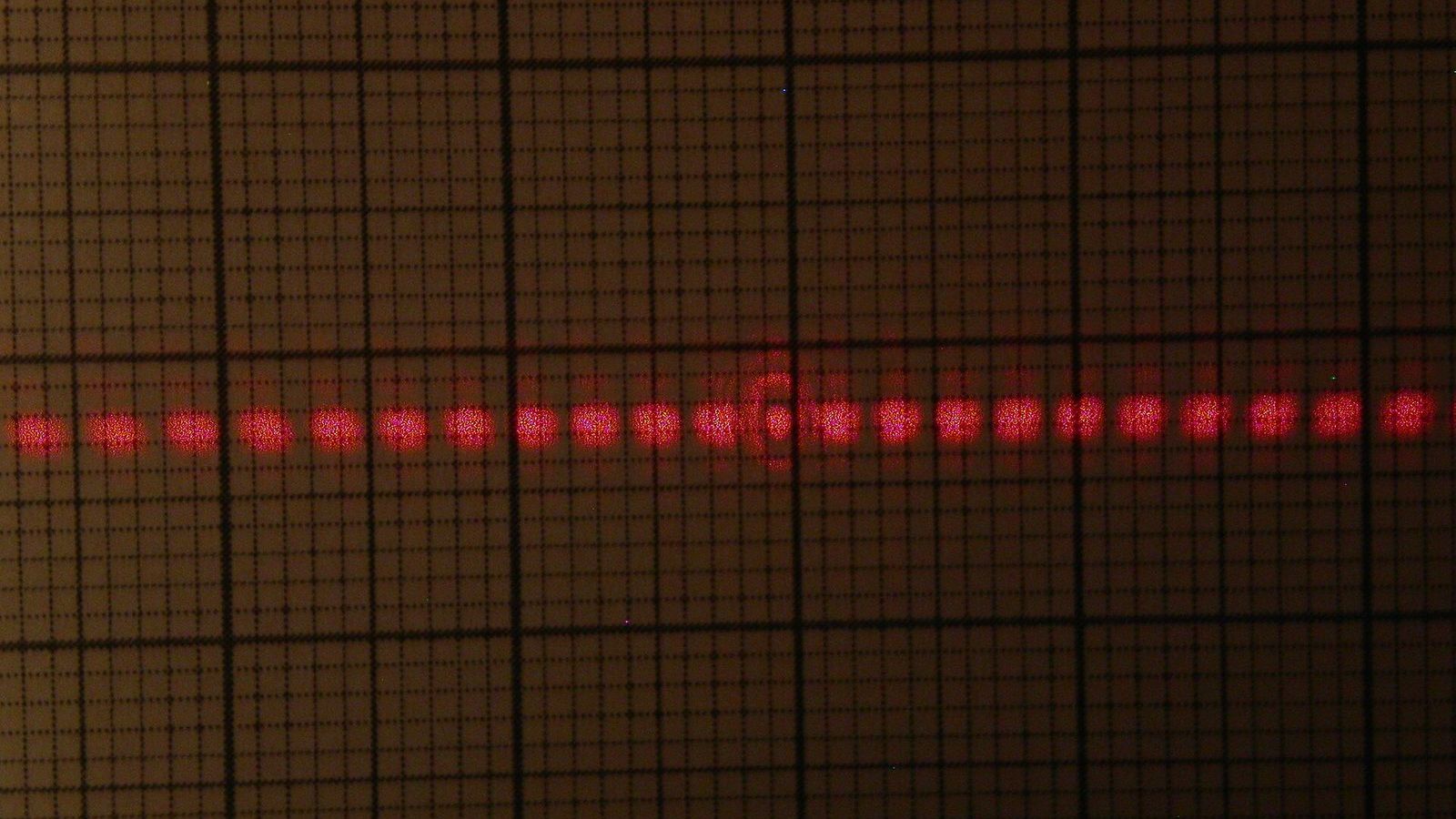
Send a beam of electrons, or photons, at a wall with a single narrow slit of width \(a\). Each particle that passes has been localized in the sideways direction to within \(a\). Behind the slit the beam spreads out into a diffraction pattern, and the spreading angle grows as the slit is made narrower. The sideways momentum of the particles after the slit has a spread of about \(h/a\), as the inequality demands. Nobody measured anything; the slit prepared a state, and the state had the spread.
The picture at the top of this article is the pattern behind slits narrower than the wavelength of the light used. Make the slit very wide and the pattern shrinks to a sharp image of the slit, because a particle localized only loosely in position may have a sharp momentum.
What the microscope story got right
Heisenberg's microscope imagined finding an electron's position by scattering a photon off it. To locate the electron to within \(\Delta x\), the photon needs a wavelength no longer than about \(\Delta x\), and such a photon carries a momentum \(h/\Delta x\), some unknown part of which it hands to the electron. The product of the resolution and the kick is about \(h\).
The story is right that measurements have costs, and right about the size of the cost in this case. Where it misleads is in suggesting that the electron had a definite position and momentum before the photon arrived and that the photon spoiled our knowledge of them. The Kennard inequality says there was nothing sharp to spoil. Niels Bohr pointed this out to Heisenberg at the time, and Heisenberg added a note to the published paper conceding it.
Measuring the disturbance
Heisenberg's original intuition, that the error of one measurement and the disturbance it causes to a second quantity obey a relation of the same form, was finally examined on its own terms in the 2000s. Masanao Ozawa in Japan showed in 2003 that the naive error-disturbance relation can be violated, and derived a corrected one with extra terms. Two experiments tested this in 2012. A group led by Yuji Hasegawa in Vienna measured the spin of neutrons along one direction and then another, and a group led by Aephraim Steinberg in Toronto did the same with the polarization of photons. Both found that the error times the disturbance could be smaller than the naive bound, while Ozawa's corrected relation held. Other physicists argued that with a different definition of error the original form survives, and the debate about definitions continues. The Kennard inequality, meanwhile, has never been in doubt.
Energy and time
A second relation of the same shape links the spread in energy of a state to the time it lasts. An excited atom that decays after a nanosecond emits light whose frequency is uncertain by about a gigahertz; a state that lives for a year has an energy defined to a precision that lets atomic clocks keep time to a second in a hundred million years. The shortest-lived particles found at the Large Hadron Collider are known only from the width of the bump in energy they produce, because they decay in \(10^{-25}\) seconds, far too fast to time with any clock. Their lifetime is read from their energy spread by this relation.
What the relation does not say
It does not say that everything is uncertain. The energy of a hydrogen atom in its ground state is known to fifteen digits. It does not say that observers create reality by looking. It does not limit how precisely position alone, or momentum alone, can be measured; either can be measured as finely as one's apparatus allows. It is a limit on the product of two spreads in one state, it follows from the wave nature of matter, and it holds for a particle nobody is watching.
In the Quantum Mechanics Masterclass the relation is first met as a rough estimate in Unit 1 and derived exactly, with the Gaussian packet and the standard deviations, in Unit 6, which also presents the 2012 experiments. The general form for any two quantities that do not commute, found by Howard Robertson in 1929, follows in Unit 9. The Important Equations page collects both.