 Image: PoorLeno, Wikimedia Commons, public domain
Why atoms do not collapse
In 1911 Ernest Rutherford showed that an atom is mostly empty space with a tiny, heavy, positive nucleus at the centre. The obvious picture, a planetary system with electrons in orbit, had a problem that every physicist of the time saw at once. An electron on a circular orbit is accelerating, and an accelerating charge radiates. The electron should lose energy, spiral inwards, and strike the nucleus. The time this takes can be computed from classical electrodynamics, and for a hydrogen atom starting at its known size it comes out at about \(1.6 \times 10^{-11}\) seconds. Atoms should not exist for longer than a hundredth of a nanosecond. They have existed for billions of years.
Why the electron cannot simply sit on the proton
Suppose the electron did fall all the way in and came to rest on the proton. Its potential energy would be enormously negative and its kinetic energy zero, which classically is the lowest energy available and therefore the state the atom should end in.
Quantum mechanics forbids this configuration, and the reason is the uncertainty relation. An electron confined to a region of size \(r\) cannot have a sharply defined momentum. The spread of its momentum is at least of the order of \(\hbar/r\), where \(\hbar\) is Planck's constant divided by \(2\pi\). A spread in momentum means kinetic energy, roughly \(p^2/2m\) with \(p \approx \hbar/r\). Squeeze the electron into a smaller region and its kinetic energy rises as \(1/r^2\), while the potential energy only falls as \(1/r\). At small enough \(r\) the kinetic term always wins. The electron cannot sit still on the proton for the same reason that a wave cannot be confined to a point.
The one-line estimate
Write the total energy of an electron confined to a region of size \(r\) as
\[ E(r) \approx \frac{\hbar^2}{2 m r^2} - \frac{e^2}{4\pi\varepsilon_0 r}. \]The first term is the kinetic energy forced by confinement, the second is the electrostatic attraction of the proton. For large \(r\) the second term dominates and the energy is negative but small; for small \(r\) the first term dominates and the energy is large and positive. In between there is a minimum. Setting the derivative to zero gives
\[ r_0 = \frac{4\pi\varepsilon_0 \hbar^2}{m e^2} = 0.0529 \text{ nm}, \]which is the Bohr radius, the accepted size of the hydrogen atom in its ground state. Putting this back into \(E(r)\) gives
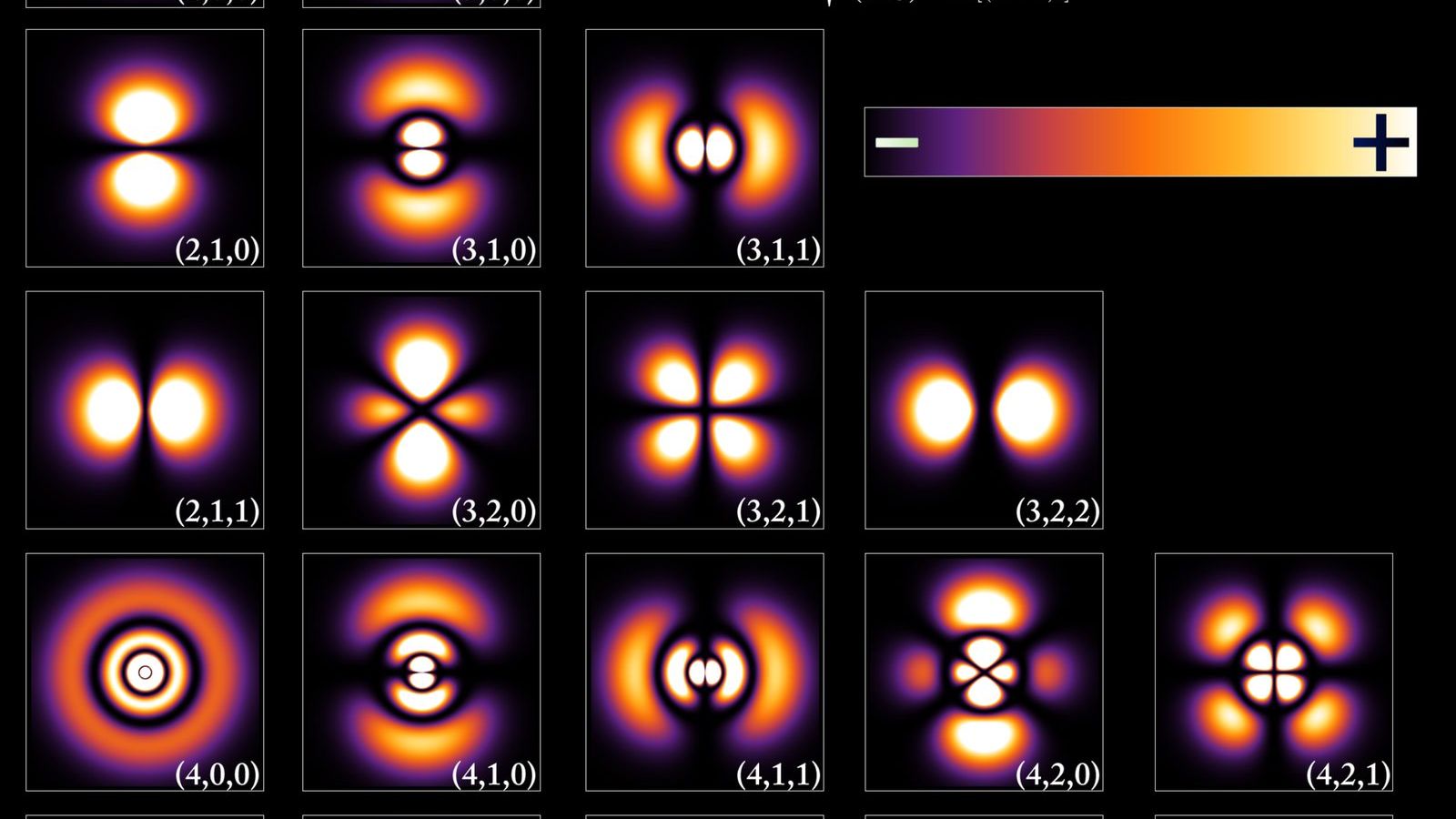
\[ E_0 = -\frac{m e^4}{2(4\pi\varepsilon_0)^2 \hbar^2} = -13.6 \text{ eV}, \]which is the measured energy needed to pull the electron off a hydrogen atom. A rough argument about spreads in position and momentum, with no orbits and no equations of motion, gives both the size and the binding energy of the atom correctly. That the numbers come out exactly rather than approximately is partly luck in the choice of \(p \approx \hbar/r\), but the orders of magnitude are no accident. The full solution of the Schrödinger equation gives the same \(r_0\) and \(E_0\), and it shows that the ground state is a stationary cloud of probability around the nucleus, densest at the centre and extending to about one Bohr radius, with nothing moving in a circle.
Why the ground state does not radiate
The classical electron radiates because its charge accelerates. In the quantum ground state, the probability cloud does not change in time at all; the wave function oscillates in phase, but the probability density, which is what determines the charge distribution, is constant. A constant charge distribution produces a constant electric field and radiates nothing. There is also nowhere lower to go. The state with energy \(-13.6\) eV is the lowest that the equations allow, and an atom in it has no energy to give away.
Excited states do radiate, and quickly. An electron in the second level of hydrogen falls back to the first in about \(1.6 \times 10^{-9}\) seconds and emits a photon of ultraviolet light at 121.6 nm. The classical collapse time and the quantum lifetime of an excited state are both tiny by human standards. The difference is that the quantum atom has a floor.
Scaling up
The same estimate shows how atoms of other elements behave. For a nucleus with \(Z\) protons and a single electron, the attraction is \(Z\) times stronger, the radius shrinks to \(r_0/Z\), and the binding energy grows to \(13.6\,Z^2\) eV. The innermost electrons of uranium, with \(Z = 92\), are bound by more than a hundred thousand electron volts and sit in a region about a hundred times smaller than a hydrogen atom. Their speed is a large fraction of the speed of light, which is why heavy elements need relativistic corrections and why gold is yellow and mercury is liquid.
Neutron stars show the other end of the scale. There the pressure of gravity is so large that electrons are squeezed into the protons after all, forming neutrons, and the confinement energy of the uncertainty relation, now for the neutrons themselves, is what holds the star up against further collapse. A neutron star is a nucleus the size of a city, and the same formula that gives the size of a hydrogen atom, with the neutron mass and the gravitational attraction in place of the electrostatic one, gives a radius of about ten kilometres.
History in two sentences
Niels Bohr guessed the right size and energy levels in his paper of 1913 by postulating orbits whose angular momentum came in multiples of \(\hbar\), without being able to say why the lowest orbit did not radiate. Werner Heisenberg's uncertainty relation of 1927 and Schrödinger's wave equation of 1926 together supplied the reason, and estimates of the kind given above, which Heisenberg discussed in his own writings, show that the stability of the atom follows from the relation. The accepted value of the Bohr radius is kept by NIST, with eleven significant figures.
In the Quantum Mechanics Masterclass, the uncertainty relation is derived properly in Unit 6, including this estimate, and Unit 7 solves the hydrogen atom exactly, with the energy levels, the shapes of the orbitals, and the measured spectrum. The two units together answer the question Rutherford's students asked in 1911.