 Image: Compound Interest (Andy Brunning), Wikimedia Commons, CC BY 4.0
Why the periodic table has the shape it has
Dmitri Mendeleev arranged the elements by weight in 1869 and noticed that their properties repeated. He left gaps for elements not yet found and predicted their properties, and when gallium and germanium turned up with the predicted densities and melting points, the table was accepted. Why the properties repeated, and why the periods had the lengths they had, nobody knew for another fifty-six years. The answer came in 1925 from Wolfgang Pauli, and it is a rule about what electrons may not do.
The states of one electron
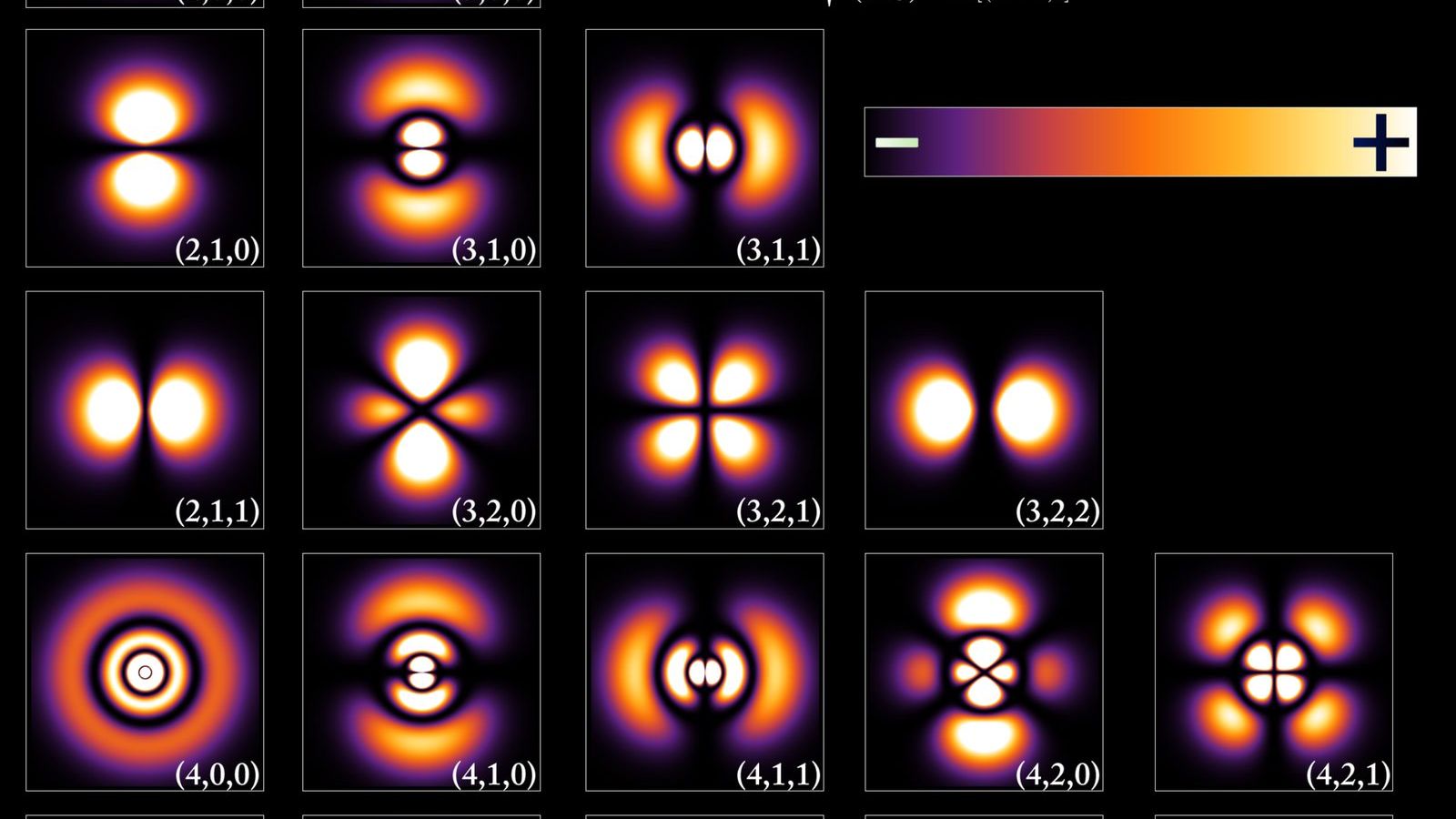
Solve the Schrödinger equation for one electron attracted to a nucleus and the allowed states come labelled by three whole numbers. The principal number \(n\) runs from 1 upwards and sets the energy and the size of the orbital. For each \(n\), the orbital angular momentum number \(l\) runs from 0 to \(n - 1\), giving the orbital its shape: a sphere for \(l = 0\), two lobes for \(l = 1\), and more complicated forms beyond. For each \(l\), the magnetic number \(m\) runs from \(-l\) to \(+l\), giving \(2l + 1\) orientations. Counting the combinations for a given \(n\) gives \(n^2\) orbitals: 1 for \(n = 1\), 4 for \(n = 2\), 9 for \(n = 3\).
Each orbital can hold an electron with spin up or spin down, which doubles the count to \(2n^2\): 2, 8, 18, 32. Those are the lengths of the rows of the periodic table, almost.
The rule
Pauli's exclusion principle says that no two electrons in an atom can occupy the same state, where a state means an orbital together with a spin direction. Without this rule every electron in every atom would drop into the \(n = 1\) orbital, all atoms would be roughly the same size, and chemistry would not exist. With it, the electrons of an atom with many protons fill the available states from the bottom up, like water filling a vessel with shelves. Hydrogen has one electron in the lowest orbital, helium two, and the first shelf is full. Lithium's third electron must go to \(n = 2\), where it sits far from the nucleus, loosely held, and ready to react. That is why lithium is a soft metal and helium is a gas that reacts with nothing.
The chemistry of an element is set by its outermost electrons, because those are the ones that meet other atoms. Elements with the same number of outer electrons in the same kind of orbitals behave alike, and they fall into the same column. The rows end where a shell is full and the next electron has to start a new one.
Why the rows are 2, 8, 8, 18, 18
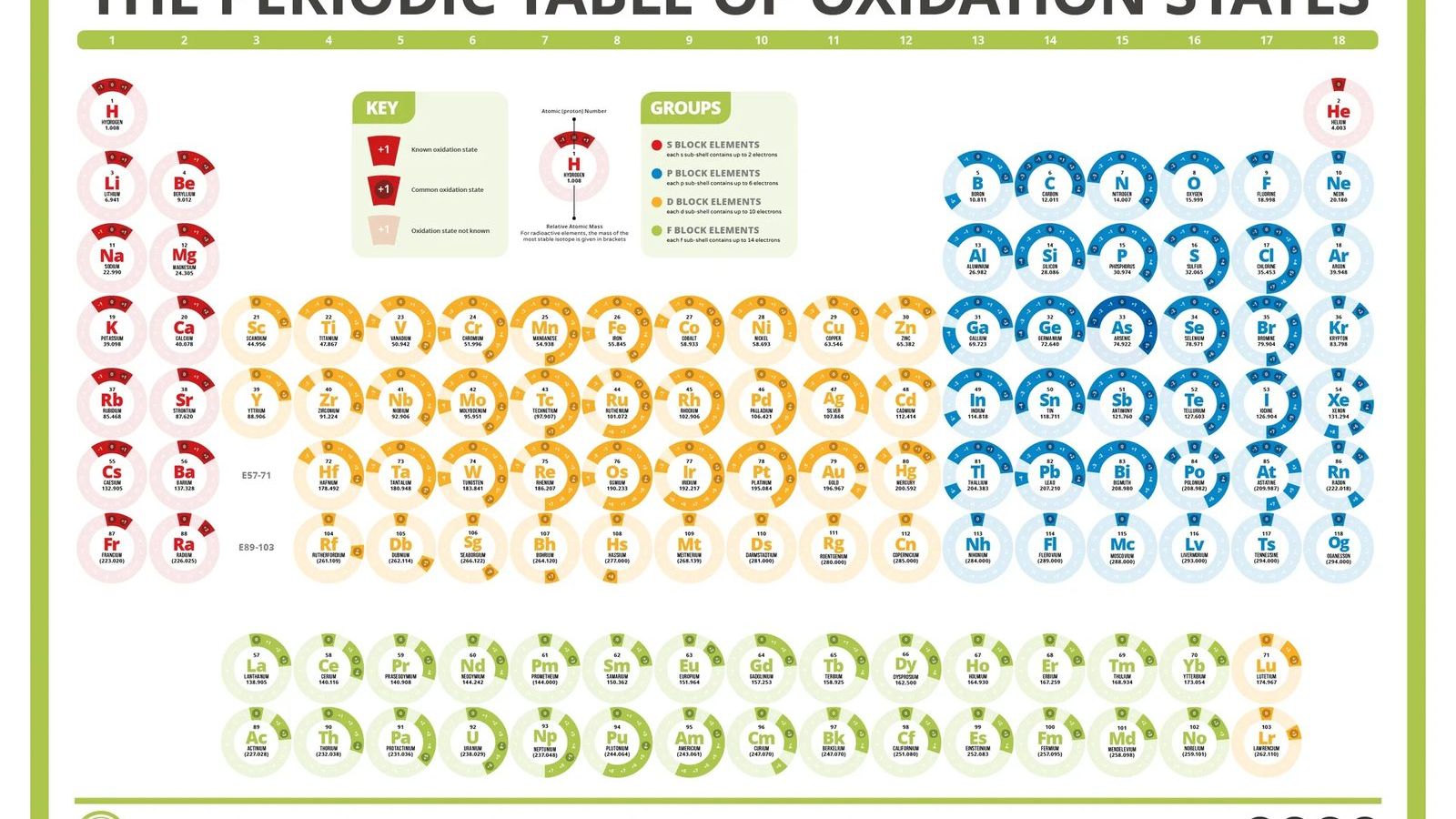
The count \(2n^2\) predicts rows of 2, 8, 18, and 32, but the actual rows are 2, 8, 8, 18, 18, 32, 32. The discrepancy comes from the other electrons. In hydrogen all orbitals with the same \(n\) have the same energy, but in an atom with many electrons the inner electrons screen the nuclear charge, and an orbital that reaches closer to the nucleus, which the low-\(l\) orbitals do, feels more of the charge and sits lower in energy. The \(4s\) orbital, which has a small inner lobe near the nucleus, ends up below the \(3d\) orbitals. So after argon fills the \(3s\) and \(3p\) orbitals with 8 electrons, the next two, potassium and calcium, go into \(4s\), and only then do the ten \(3d\) electrons of the transition metals from scandium to zinc follow. The third row has 8 elements and the fourth has 18, and the same delay repeats for \(5s\) before \(4d\), and for the \(f\) orbitals that produce the two long rows at the bottom.
The order of filling is summarized by a rule of thumb: orbitals fill in order of increasing \(n + l\), and for equal \(n + l\), in order of increasing \(n\). It is a rule of thumb because it is not exact. Chromium places one electron in \(4s\) and five in \(3d\) rather than two and four, and copper puts one in \(4s\) and ten in \(3d\). A half-filled or full set of \(d\) orbitals is slightly favoured by the way the electrons avoid each other, and the energies are close enough for that to tip the balance. The measured configurations at NIST list about twenty such exceptions among the heavier elements.
Reading the shells from the ionization energies
The most direct evidence for shells is the energy needed to remove one electron from each element. Helium needs 24.6 eV, the highest of all. Lithium needs 5.4 eV, because its outer electron is in a new shell, further out and screened by the two inner ones. Across the second row the energy climbs, with two small dips, to 21.6 eV at neon, then drops to 5.1 eV at sodium. Argon is at 15.8 eV and potassium at 4.3 eV. Plotted against atomic number, the ionization energy is a saw-tooth, with the teeth at the noble gases and the notches at the alkali metals, and the length of each tooth is the length of the row.
The small dips within a row are the exclusion principle at finer resolution. Boron needs less energy than beryllium because its fifth electron starts the \(2p\) orbitals, which lie above \(2s\). Oxygen needs less than nitrogen because nitrogen's three \(2p\) electrons each have an orbital to themselves, with parallel spins, while oxygen's fourth must share an orbital with another electron, where the two repel each other more strongly.
What Pauli saw
Pauli arrived at the principle from the spectra of atoms in magnetic fields, before spin was discovered, and had to introduce a fourth quantum number with two values that he could not explain. Within the year, Uhlenbeck and Goudsmit identified it as spin. The deeper reason for the principle, which Pauli proved in 1940, is that electrons are identical particles whose combined wave function changes sign when any two are swapped, and such a wave function vanishes if two electrons are put in the same state. Particles with this property are called fermions, and all the matter that is rigid, from a table to a neutron star, is rigid because of it. Pauli received the Nobel Prize in Physics 1945, nominated by Einstein.
In the Quantum Mechanics Masterclass, the counting of hydrogen states is done in Unit 7, spin is added in Unit 11, and Unit 12 states the exclusion principle in its exact form, builds the periodic table from it, and plots the saw-tooth from the NIST data, which is also that unit's tool of the week. The full list of units is in the curriculum.