In 1900 Planck could only fit the glow of a hot body by letting energy come in portions of size hf, and within a quarter of a century these portions had become particles. This unit derives Planck's radiation law from the quantum hypothesis, explains the photoelectric effect with Einstein's equation and Millikan's measurements, computes the energy and momentum of a photon, and shows in Compton's experiment that a photon collides with an electron like a particle. It ends with the Paris experiment that counts the photons in a box without absorbing them.
Preview: the beginning of the unit
Every hot object glows, and the colour of the glow follows the temperature and nothing else. A poker in a fire turns dull red, then orange, then yellow, and the filament of a bulb glows white because it is hotter still. In 1900 nobody could calculate this colour from the physics of the day, and the formula that finally fitted the measurements needed an assumption that its author did not believe. This unit follows that assumption through three experiments. Planck’s radiation law introduced the constant \(h\), Einstein used it to explain why light of the wrong colour frees no electrons from a metal however bright it is, and Compton showed that a quantum of light carries momentum like a billiard ball. The unit ends with an experiment that counts the photons in a box one by one without destroying them.
1 Black-body radiation and the failure of classical physics
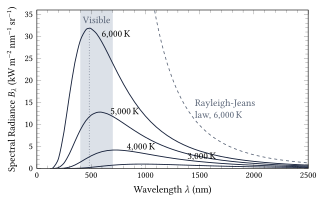
Every hot body radiates, and the simplest radiator to study is a body that absorbs all the radiation that falls on it, which is called a black body. No paint is perfectly black, but a small hole in the wall of a closed oven comes close, because light that enters through the hole is reflected inside the cavity until it is absorbed. Gustav Kirchhoff (1824-1887) showed in 1859 that the radiation leaving such a hole depends only on the temperature of the walls and not on their material, which made the black body the natural object to measure and to explain. The quantity to measure is the spectral radiance\(B_\lambda(T)\), which is the power that one square metre of the surface sends into a given direction, divided by the solid angle of that direction (the measure of how wide a cone of directions is, in the unit steradian, sr) and by the interval of wavelength considered. The axis of Figure 1, which shows it for four temperatures, therefore carries the unit \(\unit{kW\,m^{-2}\,nm^{-1}\,sr^{-1}}\). At 3,000 K only the red end of the visible band receives noticeable power, which is why a poker glows red first; at 6,000 K every colour does, and the eye reports the mixture as white.
Figure 1. The spectral radiance of a black body at 3,000 K, 4,000 K, 5,000 K, and 6,000 K, computed from Planck’s radiation law, with the visible band from 400 to 700 nm shaded. The peak moves to shorter wavelengths and the whole curve rises as the temperature grows. The dashed curve is the Rayleigh-Jeans law for 6,000 K, which agrees with the measured curve at long wavelengths and rises without limit at short ones.
Two regularities were known before the shape of the curve was understood. Wilhelm Wien (1864-1928) found in 1893 that the wavelength of the peak is inversely proportional to the temperature, so that doubling the temperature halves it. Earlier, in 1879, Josef Stefan (1835-1893) had concluded from the measurements of others that the total power radiated per unit area grows with the fourth power of the temperature, and Ludwig Boltzmann (1844-1906) derived this law from thermodynamics in 1884.