 Image: Graham Beards, Wikimedia Commons, CC BY-SA 4.0
The double-slit experiment with one electron at a time
The first frame shows eleven dots scattered across a dark field. The second shows about two hundred, still looking random. At six thousand the eye begins to suspect stripes, at forty thousand the stripes are plain, and at one hundred and forty thousand there is no doubt: bright bands and dark bands, the pattern a wave makes when it passes through two openings and meets itself on the other side. The dots are electrons. Each arrived alone.
The experiment
Akira Tonomura and his colleagues at the Hitachi Advanced Research Laboratory published the film in 1989. Their electron source was the tip of a field-emission microscope, and the electrons were accelerated through 50,000 volts, which gives them a de Broglie wavelength of about 5 picometres, a hundred times smaller than an atom. Instead of two slits cut in a plate, which would have to be impossibly fine, they used an electron biprism: a thin wire, positively charged, between two grounded plates. An electron wave passing on either side of the wire is bent towards the middle, and the two halves overlap on a detector further on, exactly as the two beams from a double slit do.
The detector recorded each electron as a single flash at a single place. The beam was so weak that successive electrons were separated, on average, by far longer than the few nanoseconds each one needed to cross the apparatus. At any moment the chance that two electrons were in the instrument together was close to zero. Nothing was there for an electron to interfere with except itself. The film ran for twenty minutes, and Hitachi still shows it online.
Tonomura's was not the first such experiment. Claus Jönsson in Tübingen made real slits for electrons in 1961, and in 1974 Pier Giorgio Merli, Gian Franco Missiroli, and Giulio Pozzi in Bologna recorded single-electron fringes with a biprism and published them in 1976. Richard Feynman, in his lectures of the early 1960s, had presented the single-electron double slit as a thought experiment that contains the whole mystery of quantum mechanics, and he believed it could not actually be performed. By the time of his death in 1988 it had been performed twice, and in 2002 readers of Physics World voted it the most beautiful experiment in physics.
Why the dots are particles
Every electron lands at one point. The detector never registers half an electron here and half there, and it never records a faint stripe that gets brighter as more charge arrives. The charge, the mass, and the energy of each electron arrive whole, at one place, at one time. In that sense the electron is a particle, and no experiment has ever found otherwise.
Where a given electron lands cannot be predicted. The first eleven dots in the film are scattered without visible rule. What can be predicted is the probability that an electron lands in a given strip of the screen, and that probability is what the pattern of a hundred and forty thousand dots displays.
Why the pattern is a wave
The probability is not what a particle picture gives. If each electron went past the wire on one definite side, the electrons that went left would form one blob on the screen and the electrons that went right would form another, and the total would be the sum of two blobs. There would be no dark bands, because adding electrons cannot subtract electrons.
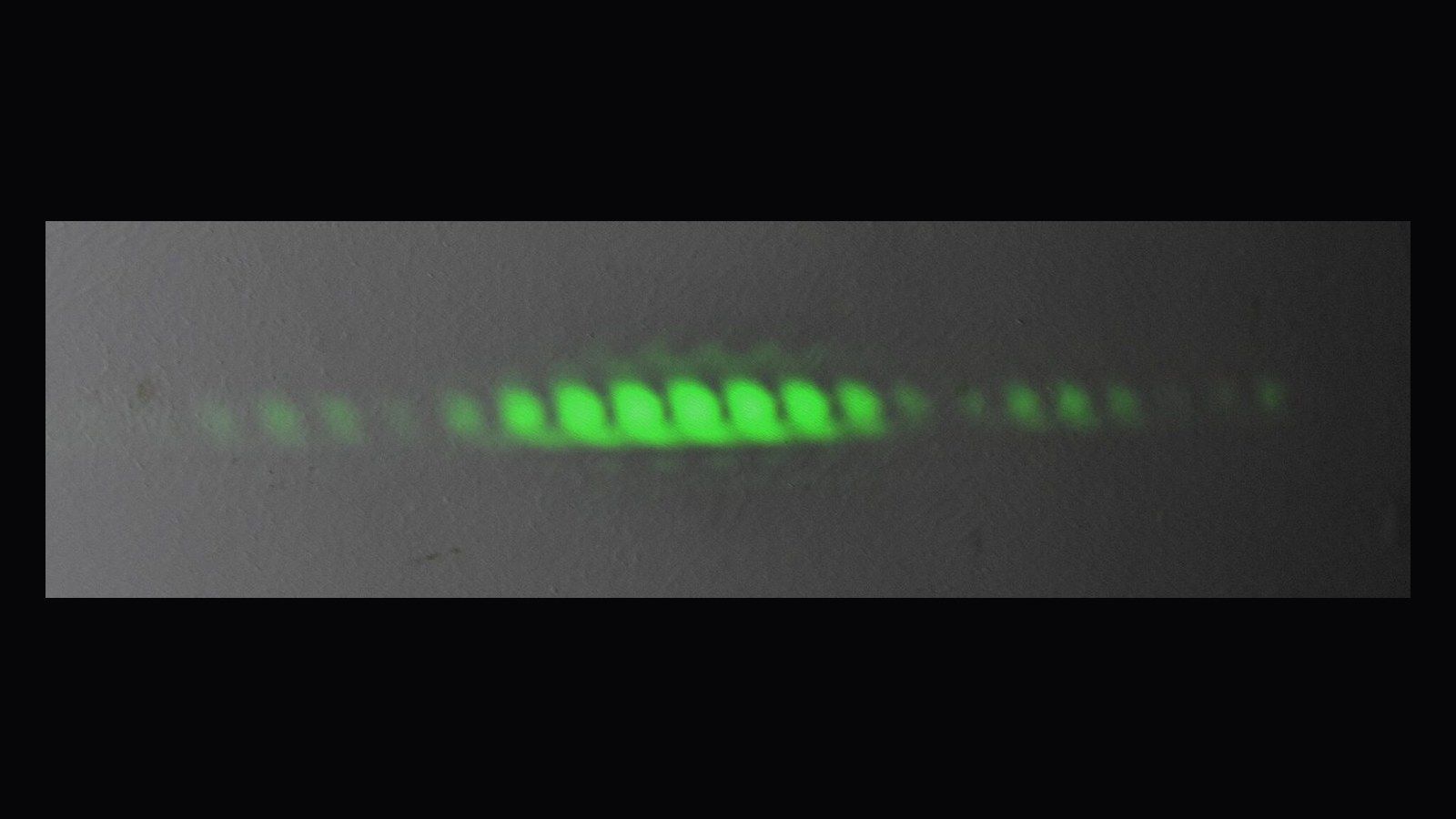
A wave gives the dark bands at once. A wave of wavelength \(\lambda\) passing two openings a distance \(d\) apart arrives at a screen a distance \(L\) away as two overlapping waves. Where the paths from the two openings differ by a whole number of wavelengths, the crests coincide and the wave is strong. Where they differ by half a wavelength, crest meets trough and the wave vanishes. The bright bands are spaced by
\[ \Delta y = \frac{\lambda L}{d}, \]and in the Hitachi film the spacing matched the de Broglie wavelength of the electrons. The quantity that interferes is the wave function. Its square gives the probability of finding the electron at each point, and where the wave function cancels, no electron ever lands.
The strange sentence that quantum mechanics asks us to accept is the following one. The probability for each single electron is computed from a wave that passes on both sides of the wire. The electron is found whole on one side or the other; the wave that decides where it may be found passes on both.
What happens when you look
The natural question is which side each electron went. The experiment has an answer, and it is the second half of the lesson. Put a device near one path that records whether an electron passed, say a cavity that picks up a small signal from the passing charge, and the stripes disappear. The screen shows the two overlapping blobs that a particle picture predicted all along.
This has been tested in many forms, with electrons, atoms, and photons. The pattern does not depend on whether a human reads the record. It depends on whether a record exists anywhere in the universe. If the path information is stored in some other system, even one nobody ever reads, the interference is gone. If the information is erased again before the electron reaches the screen, in a scheme called a quantum eraser, the stripes come back. Interference requires that no part of the world has kept track of which way the electron went. Niels Bohr called the two behaviours complementary: an experiment can show the path or the stripes, never both at once.
How big can the particle be?
Electrons are light, and their wavelength at ordinary speeds is comparable to the spacing of atoms, which made the first experiments possible. Heavier objects have shorter waves. A group in Vienna led by Markus Arndt has pushed the double slit, in the form of a three-grating interferometer, to molecules of 810 atoms and more than 10,000 atomic mass units in 2013, and to molecules above 25,000 atomic mass units in 2019. These are objects you can draw, with a carbon skeleton and fluorine atoms hanging off it, and they interfere with themselves when nothing records their path. Where the limit lies, if there is one, is an open research question.
What the five frames teach
The electron is detected as a particle and propagates as a wave. Those are two statements about two different parts of an experiment, the arrival and the passage, and there is no contradiction between them once you stop asking what the electron is doing in between, because the only way to find out is to change the experiment.
In the Quantum Mechanics Masterclass, Unit 3 computes the de Broglie wavelength of electrons, atoms, and a tennis ball, explains the Davisson-Germer experiment that first diffracted electrons from a crystal in 1927, derives the fringe spacing above, and presents the Hitachi film and the molecule experiments in detail. It is the free sample unit of the program, and its first pages are on the home page. The wave function itself, and the equation that governs it, follow in Unit 4.