 Image: Dasha Butova, Wikimedia Commons, CC BY-SA 4.0
What a photon is and what it is not
A green laser pointer with a power of one milliwatt sends out about 2.7 million billion photons every second. Each of them carries the same energy, 2.33 electron volts, and the colour of the beam is nothing other than that number. If you want to understand what a photon is, start there, with the energy, and leave the pictures of little balls of light for later.
The energy of one photon
Light of frequency \(f\) comes in portions of energy
\[ E = hf = \frac{hc}{\lambda}, \]where \(h\) is Planck's constant, \(6.626 \times 10^{-34}\) joule seconds, \(c\) is the speed of light, and \(\lambda\) is the wavelength. The product \(hc\) is worth remembering as 1240 electron volt nanometres. For the green pointer, with \(\lambda = 532\) nm, the energy of one photon is 1240 divided by 532, which is 2.33 eV, or \(3.7 \times 10^{-19}\) joules. One milliwatt is one millijoule per second, and dividing by \(3.7 \times 10^{-19}\) gives the \(2.7 \times 10^{15}\) photons per second from the first paragraph.
Red light has longer waves and therefore smaller portions, about 1.9 eV at 650 nm. Ultraviolet at 250 nm comes in portions of 5 eV, which is enough to break chemical bonds, and that is why ultraviolet light burns skin and visible light does not. X-ray photons carry thousands of electron volts and gamma-ray photons millions. The brightness of a light source tells you how many photons arrive per second. The colour tells you how much energy each one brings.
A photon also carries momentum, \(p = h/\lambda\), even though it has no mass. For green light that is \(1.2 \times 10^{-27}\) kilogram metres per second, a tiny amount, but \(10^{15}\) of them per second add up to a measurable push. Light pressure holds comet tails pointing away from the Sun, and in 2010 the Japanese spacecraft IKAROS sailed on sunlight alone.
How we know light comes in portions
Shine light on a clean metal surface in a vacuum and electrons come out. This is the photoelectric effect, and the German physicist Philipp Lenard measured its strange rules in 1902. Making the light brighter produced more electrons but did not make any of them faster. Changing the colour did: below a certain frequency, which depends on the metal, no electrons came out at all, however bright the lamp. Above it, the fastest electrons had an energy that grew in a straight line with the frequency.
Waves cannot do this. A wave delivers energy continuously, so a bright enough lamp of any colour should eventually shake electrons loose. In 1905 Albert Einstein proposed the explanation in a paper in the Annalen der Physik: the light arrives in portions of energy \(hf\), an electron absorbs one portion at a time, it pays an energy \(\phi\) to leave the metal, and it keeps the rest:
\[ K_{\max} = hf - \phi. \]The quantity \(\phi\), the work function, is about 2.3 eV for sodium and about 4.5 eV for tungsten. The slope of the straight line is \(h\), the same constant Max Planck had introduced five years earlier for an entirely different problem, the glow of hot objects. Robert Millikan spent a decade trying to prove Einstein wrong and in 1916 published the most precise measurement of \(h\) of his time, from exactly this straight line. Einstein received the Nobel Prize in Physics 1921 for the photoelectric law, and the word photon was coined by the chemist Gilbert Lewis in 1926.
Counting photons
Today a single photon is something you can detect with a click. An avalanche photodiode turns one absorbed photon into a pulse of millions of electrons. Superconducting nanowire detectors, cooled to about one kelvin, register a photon with an efficiency above 98 percent and time its arrival to a few billionths of a second. Astronomers count photons from distant galaxies one by one, and the night sky seen by a large telescope is a trickle of clicks.
The decisive test of the portion picture was done in 1986 by Philippe Grangier, Gérard Roger, and Alain Aspect in Orsay. They prepared light in such a way that photons arrived one at a time, sent each one at a half-silvered mirror, and placed a detector on each side. A wave would split at the mirror and both detectors would sometimes fire together. They never did. Each photon went one way or the other, whole.
What a photon is not
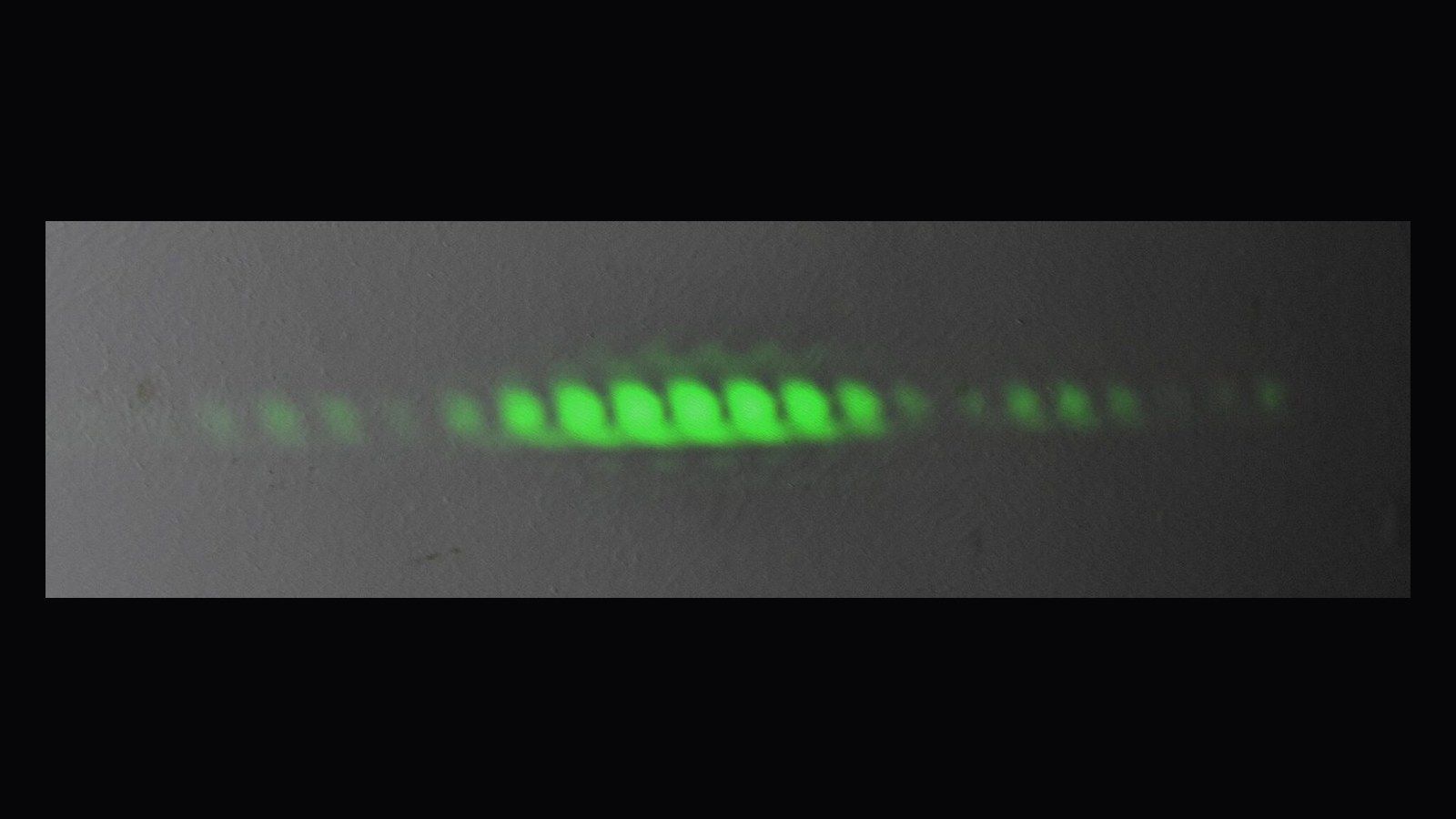
The same photons, sent one at a time through two slits, build up an interference pattern on a screen behind them, dot by dot. A ball that goes through one slit cannot know where the other slit is, so the ball picture fails. A photon is not a small bright sphere flying along a line.
Nor is a photon a short pulse of light. A pulse can be made as weak as you like and still be a pulse. The photon is the smallest step by which the energy in a light field of a given frequency can change, and a field can hold one portion spread over a region many metres across. In an experiment with an optical cavity, one photon lives for a tenth of a second bouncing between two mirrors, and the whole volume between the mirrors holds exactly one portion.
A photon has no mass and no electric charge, it always travels at the speed of light, and it cannot be slowed down and held in one place the way an electron can. What it has is energy, momentum, a polarization, and a phase. The right picture is an excitation of a wave field that can only be created or destroyed whole. The rules for how such excitations interfere, and when they do not, are the subject of the first three units of the masterclass.
Numbers to keep
| Light | Wavelength | Photon energy |
|---|---|---|
| FM radio | 3 m | 0.4 µeV |
| Microwave oven | 12 cm | 10 µeV |
| Body heat (infrared) | 10 µm | 0.12 eV |
| Red light | 650 nm | 1.9 eV |
| Green light | 532 nm | 2.33 eV |
| Ultraviolet (sunburn) | 300 nm | 4.1 eV |
| Dental X-ray | 0.02 nm | 60 keV |
Each of these numbers comes from the single relation \(E = hc/\lambda\) with \(hc = 1240\) eV nm. Radio photons are so small in energy that a transmitter emits \(10^{30}\) of them a second and nobody will ever count them individually. X-ray photons are so large that a single one can ionize hundreds of atoms along its path.
In the Quantum Mechanics Masterclass, Unit 2 works through Planck's radiation law, the photoelectric effect with Millikan's data, and Compton scattering, which is where the momentum of the photon shows itself. Unit 3 then turns the argument around and asks whether electrons, which everyone agrees are particles, also behave as waves. The full list of units is in the curriculum.