 Image: Vyacheslav Argenberg, Wikimedia Commons, CC BY 4.0
Schrödinger's cat, without the mysticism
Erwin Schrödinger did not like the cat. He introduced it in 1935, in a long article in the journal Die Naturwissenschaften, as a "ridiculous case", and his point was that if the new quantum mechanics were taken as a complete description of the world, it would lead to this absurdity. Ninety years later the cat appears on T-shirts as the mascot of quantum weirdness. Its inventor would have been annoyed.
What the thought experiment says
A cat is shut in a steel box together with a small amount of a radioactive substance, a Geiger counter, a hammer, and a flask of hydrocyanic acid. The amount of substance is chosen so that in one hour there is a 50 percent chance that one atom decays. If an atom decays, the counter fires, the hammer falls, the flask breaks, and the cat dies. If not, the cat lives.
The decay of a single atom is a quantum event, and quantum mechanics describes the atom after one hour by a wave function that is a superposition of decayed and not decayed, with equal weights. The counter, the hammer, the flask, and the cat are all made of atoms, and if the same equations apply to them, then after one hour the wave function of the whole box is a superposition of a dead cat and a living cat. Schrödinger wrote that this "psi-function of the entire system would express this by having in it the living and dead cat (pardon the expression) mixed or smeared out in equal parts."
Only when the box is opened, according to the standard rules, does the superposition collapse to one of the two outcomes. Schrödinger's question was where, between the atom and the observer, the smearing is supposed to stop, and why.
What the argument was for
The article was written in the months after the paper of Einstein, Podolsky, and Rosen, which argued that the wave function cannot be a complete description of a physical system. Schrödinger agreed with Einstein and corresponded with him that summer. The same article coined the word Verschränkung, entanglement, for the way two quantum systems that have interacted share a single wave function, and in a second paper that year, written in English for the Cambridge Philosophical Society, he called this "the characteristic trait of quantum mechanics".
The cat is an entanglement argument. The atom becomes entangled with the counter, the counter with the hammer, and so on until the cat is entangled with the atom. Schrödinger's objection was to a reading of the wave function as a description of reality itself. If the wave function is the whole story, the cat is in two states. Since nobody has ever seen such a cat, something in the story is missing, or the wave function describes our knowledge and not the cat. He did not claim to know which.
Why you will never meet a superposed cat
The modern answer to half of the puzzle is called decoherence, worked out from 1970 onwards by Dieter Zeh in Heidelberg and Wojciech Zurek at Los Alamos. A superposition shows itself through interference, as in the double slit, where the two branches of the wave function overlap and produce stripes. Interference requires that nothing in the environment has recorded which branch is which.
A cat cannot be isolated. It is warm, it breathes, it scatters light, and the air molecules that bounce off it carry away information about where it is and whether it is moving. Within a time far shorter than any clock can measure, the state of the air, the box, and the thermal radiation inside it differ completely for the two branches, and no experiment on the cat alone can ever bring the branches together to interfere. For all practical purposes the superposition has become an ordinary either-or, a cat that is dead or alive and we do not yet know which. Decoherence does not require anyone to look. It happens because a cat is large and warm.
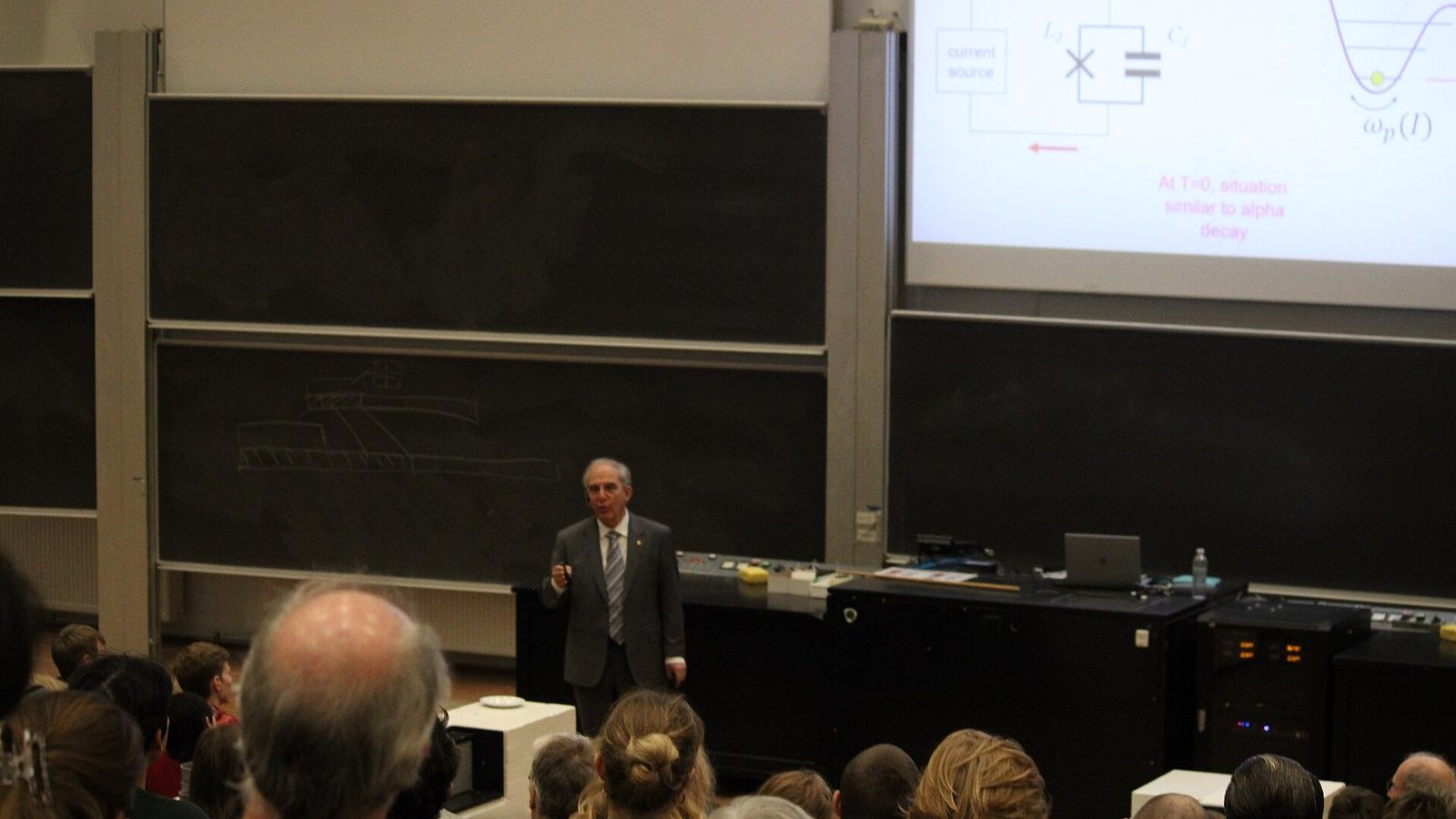
How fast this happens has been measured. In 1996 Serge Haroche's group in Paris prepared a superposition of two states of a few microwave photons in a cavity, the closest laboratory analogue of a cat, and watched the interference fade over tens of microseconds as photons leaked out and carried away the information. The larger the difference between the two states, the faster the fading, exactly as the theory predicted. Haroche shared the Nobel Prize in Physics 2012 for this line of work.
How big a superposition can be
Objects well above the atomic scale have been put into superpositions and made to interfere. Molecules of more than 25,000 atomic mass units have passed through an interferometer in Vienna. Supercurrents of billions of electrons have been placed in a superposition of flowing clockwise and anticlockwise in a superconducting ring. A vibrating membrane and a levitated glass sphere have been cooled to their quantum ground state, the first step towards superposing their positions. In each case the recipe is the same: cold, vacuum, and darkness, so that nothing in the environment can tell the branches apart.
Nobody expects to superpose a cat, and the reason is practical rather than one of principle. A cat exchanges so much information with its surroundings that isolating it is out of the question.
What remains open
Decoherence explains why we never see interference between a dead and a living cat. It does not explain why, when we open the box, we find one definite outcome rather than both. The wave function of the whole system, cat plus environment, still contains both branches; they have merely stopped talking to each other. Something more is needed to say that one of them is real.
Here the interpretations part ways, and the argument is as alive as in 1935. One school says the wave function describes our information, and finding the cat alive updates that information, as reading a newspaper does. Another says both branches are real and the observer who opens the box splits along with them; that is the many-worlds reading, first proposed by Hugh Everett in 1957. A third adds a physical collapse process that the standard equations do not contain and looks for experiments that could detect it. The Stanford Encyclopedia of Philosophy has a careful account of each. All of them agree on every measured number so far, which is why the question is hard.
What the cat is not is evidence that observation creates reality, that consciousness collapses wave functions, or that anything at all can be alive and dead at once. Schrödinger's own view, stated in the same article, was that a superposition of macroscopically different states is "a quite ridiculous case", and he meant it as a reductio, a proof that the account was incomplete. The cat has outlived its author's intention, but the physics behind it is clear, and it is taught, with the equations, in Unit 8 of the Quantum Mechanics Masterclass, after the wave function and the measurement rules have been introduced in Unit 4 and Unit 6.