 Image: Frank Behnsen, Wikimedia Commons, CC BY-SA 3.0
The postcard that split a beam of silver atoms
The apparatus was small enough to stand on a desk. A furnace heated silver to about 1,000 degrees Celsius, a narrow stream of silver atoms escaped through a slit into a vacuum, passed between the poles of a magnet shaped so that the field was much stronger near one pole than the other, and landed on a glass plate three centimetres further on. The question was whether the deposit on the plate would be a single smear, widened by the magnet, or something else. On the night of 7 to 8 February 1922 Walther Gerlach developed the plate and saw two separate lines.
The question
A silver atom is a tiny magnet, and a magnet in a non-uniform field feels a force that depends on its orientation. Classically, the atoms leave the furnace with their magnets pointing every which way, so the forces range continuously from a maximum upward to a maximum downward and the beam should spread into a band. In the old quantum theory of Bohr and Sommerfeld, the angular momentum of the atom's electron orbit, and with it the magnet, could only point in certain directions relative to the field, a rule called space quantization. Otto Stern, a theorist who had moved to experiment, proposed in 1921 that a molecular beam could decide between the two pictures. Many of his colleagues thought the quantized directions were a bookkeeping device with no physical meaning, and Stern himself expected the beam not to split.
The experiment
The difficulties were practical. The slits had to be a few hundredths of a millimetre wide, the vacuum had to hold for hours, and the deposit of silver was so thin that at first nothing could be seen on the plate. The best-known story about the experiment concerns that invisible deposit. According to Stern's own later account, he leaned over the plate to look, and the layer of silver appeared as he watched. He and Gerlach were poorly paid, they smoked cheap cigars with a high sulfur content, and the sulfur in his breath turned the invisible silver into visible black silver sulfide, the way photographic developer brings out an image. The chemists Bretislav Friedrich and Dudley Herschbach retold the story and checked its chemistry in an article in Physics Today in 2003.
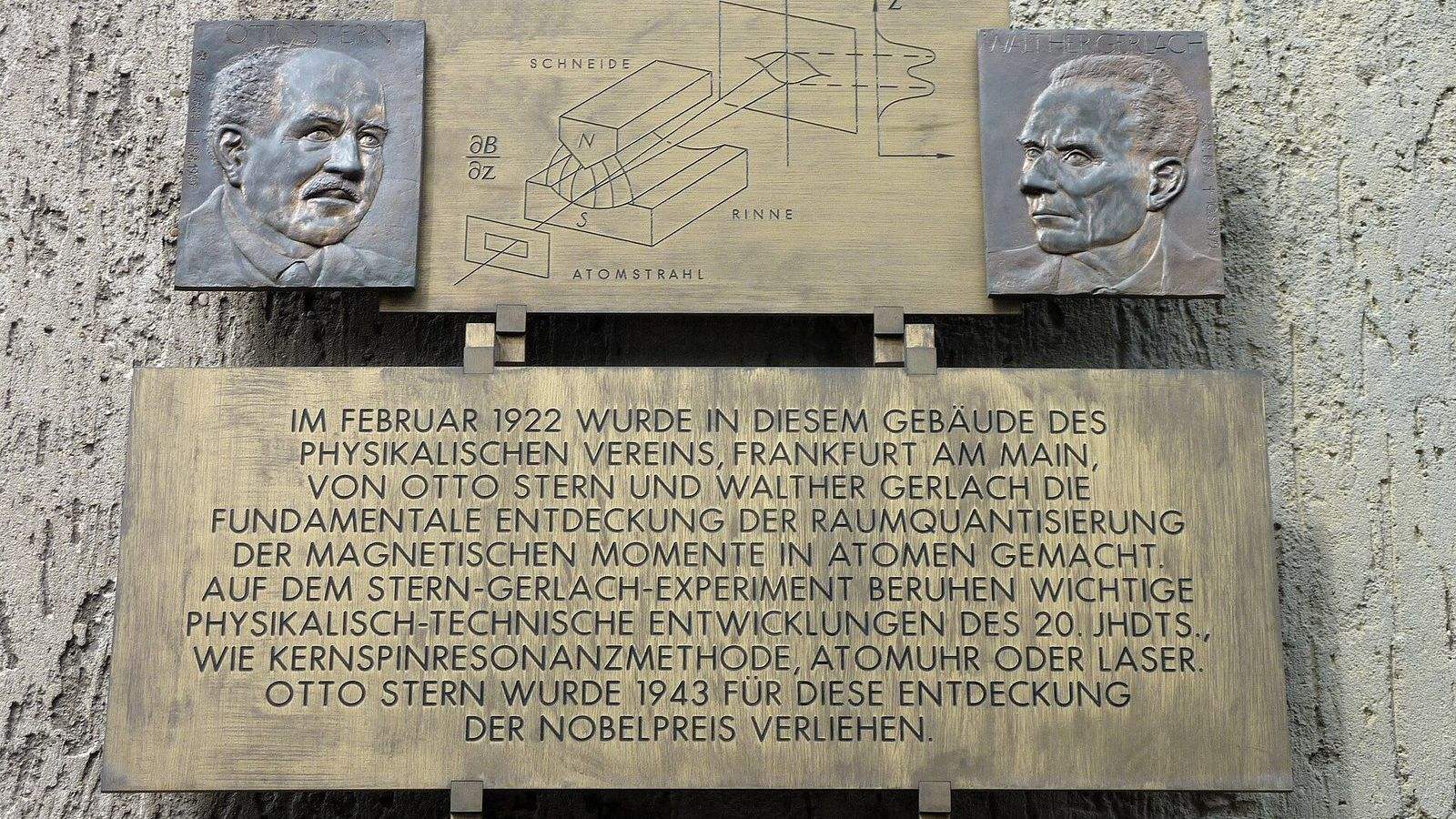
Whatever the role of the cigars, the result was unambiguous. The beam split into two, with nothing in the middle. The separation was about 0.2 mm, and from it Stern and Gerlach computed the magnetic moment of the silver atom. It came out as one Bohr magneton, the natural unit of atomic magnetism, to within about 10 percent. Gerlach sent a postcard to Niels Bohr in Copenhagen with a photograph of the split beam and the words, "we congratulate you on the confirmation of your theory." The plaque on the building of the Physikalischer Verein in Frankfurt, where the experiment was done, now marks the spot.
The confirmation that was not one
Bohr's theory had predicted a split, and a split was what they saw, so the matter seemed settled. The prediction and the observation agreed for the wrong reasons. In the Bohr-Sommerfeld picture the silver atom's outer electron had one unit of orbital angular momentum, which could point along the field, against it, or, in Sommerfeld's version, sideways. Bohr argued that the sideways orientation was forbidden, leaving two beams. That argument was wrong, and so was the premise. The outer electron of silver has no orbital angular momentum at all. By the theory the experiment was supposed to confirm, the beam should not have split.
Nobody noticed, because the theory was already known to be in trouble elsewhere and the experiment was spectacular. Einstein and Paul Ehrenfest wrote a paper in 1922 asking how the atoms could possibly line up with the field in the short time they spent in the magnet, and found no answer. The result stood as a fact in search of a theory.
Spin
In the autumn of 1925 two young physicists in Leiden, George Uhlenbeck and Samuel Goudsmit, proposed that the electron itself carries an intrinsic angular momentum of half a unit, which they called spin, with a magnetic moment of one Bohr magneton attached to it. Half a unit of angular momentum has exactly two allowed orientations along any axis, up and down, and the magnetic moment of one magneton gave the force Stern and Gerlach had measured. The silver atom's magnetism comes entirely from the spin of its single outer electron; the orbit contributes nothing. The two lines on the plate were the two orientations of the electron's spin, three years before anybody knew the electron had one.
Uhlenbeck and Goudsmit were not thinking about silver beams. They were trying to explain the fine structure of spectral lines and the anomalous splitting of lines in a magnetic field, and spin solved those problems too. Wolfgang Pauli had introduced a mysterious two-valued quantum number for the electron earlier that year to account for the structure of the periodic table; spin was what that number meant. In 1927 Thomas Phipps and John Taylor repeated the Stern-Gerlach experiment with hydrogen atoms, where there is unquestionably no orbital angular momentum, and found the same two beams.
What the experiment shows today
The Stern-Gerlach experiment is now the standard way of introducing measurement in quantum mechanics, because it is a measurement reduced to its bones. An atom goes in; one of exactly two things happens. Send the up beam through a second magnet oriented the same way and all the atoms come out up again. Turn the second magnet by ninety degrees and the up beam splits into two equal halves. Turn it back and the beam that was sorted sideways splits again into up and down, as if the first sorting had never happened. Every strange feature of quantum measurement, the discreteness of outcomes, the probabilities, the loss of one piece of information when another is obtained, appears in a sequence of three magnets.
Stern received the Nobel Prize in Physics in 1943, cited for the molecular beam method and the measurement of the magnetic moment of the proton. Gerlach, who had stayed in Germany and led its nuclear research programme during the war, did not share it. The silver atoms, the cigars, and the postcard are a reminder that a decisive experiment can be understood years after it is done.
In the Quantum Mechanics Masterclass the experiment is first mentioned in Unit 7 and analysed in full in Unit 11, which builds the spin matrices, computes the probabilities for the sequence of magnets above, and uses the same atoms in a modern interferometer on a chip. The rules of measurement it illustrates are stated in Unit 6.