 Image: Kim Traynor, Wikimedia Commons, CC BY-SA 3.0
What spin is, and why it is not spinning
When George Uhlenbeck and Samuel Goudsmit proposed in 1925 that the electron has an intrinsic angular momentum, they pictured it as a small charged sphere turning on its axis, and they named it accordingly. Their supervisor Paul Ehrenfest sent the paper off before they could withdraw it. The name has stuck for a century. The picture lasted a few weeks.
Why the electron cannot be spinning
The angular momentum of an electron's spin is \(\hbar/2\), about \(5 \times 10^{-35}\) joule seconds. Experiments that scatter electrons off each other at high energy put the electron's size at less than \(10^{-18}\) metres; even the classical electron radius of \(2.8 \times 10^{-15}\) metres, the largest size any classical model allows, is tiny. A sphere of that radius and the electron's mass, turning fast enough to carry \(\hbar/2\) of angular momentum, would have a surface speed more than a hundred times the speed of light. Hendrik Lorentz worked this out when Uhlenbeck and Goudsmit showed him the idea, and it was one of the reasons they tried to retract it.
There is a second problem. A spinning charged sphere has a magnetic moment proportional to its angular momentum, with a ratio fixed by classical physics. The electron's magnetic moment is twice as large as that ratio predicts. The factor of two, called the g-factor, has been measured as 2.00231930436, the most precisely known quantity in physics, and no spinning ball of any shape gives it. Paul Dirac's relativistic equation of 1928 produces the 2 automatically, and quantum electrodynamics produces the digits after it.
What spin is
Spin is angular momentum that a particle has without moving, in the same way that mass and charge are properties a particle has without doing anything. It is conserved together with orbital angular momentum: when an atom emits a photon, the sum of the two changes by exactly the amount the photon carries away. It responds to magnetic fields as a magnetic moment. It is as real as the electron's charge, and like the charge it is the same for every electron in the universe.
What makes spin unlike anything classical is the result of measuring it. Choose any axis. Measure the component of an electron's spin along that axis. You get \(+\hbar/2\) or \(-\hbar/2\), never anything in between, and never zero. Choose a different axis and the same is true. A classical arrow of length \(\hbar/2\) would have a component along a tilted axis somewhere between the extremes; the electron's spin never does. The electron is said to have spin one half because the largest component is half of \(\hbar\), and the number of allowed outcomes along any axis is twice that plus one, which is two.
Two numbers describe it
Because there are two outcomes, the spin state of an electron is described by two complex amplitudes, one for up and one for down along a chosen axis, with the squares of their magnitudes adding to one. Up to an overall phase that has no physical effect, this leaves two real parameters, and they can be drawn as a point on the surface of a sphere, called the Bloch sphere after Felix Bloch. The north pole is spin up along \(z\), the south pole is spin down, and a point on the equator is an equal superposition of the two, which is also the state of definite spin along some horizontal axis.
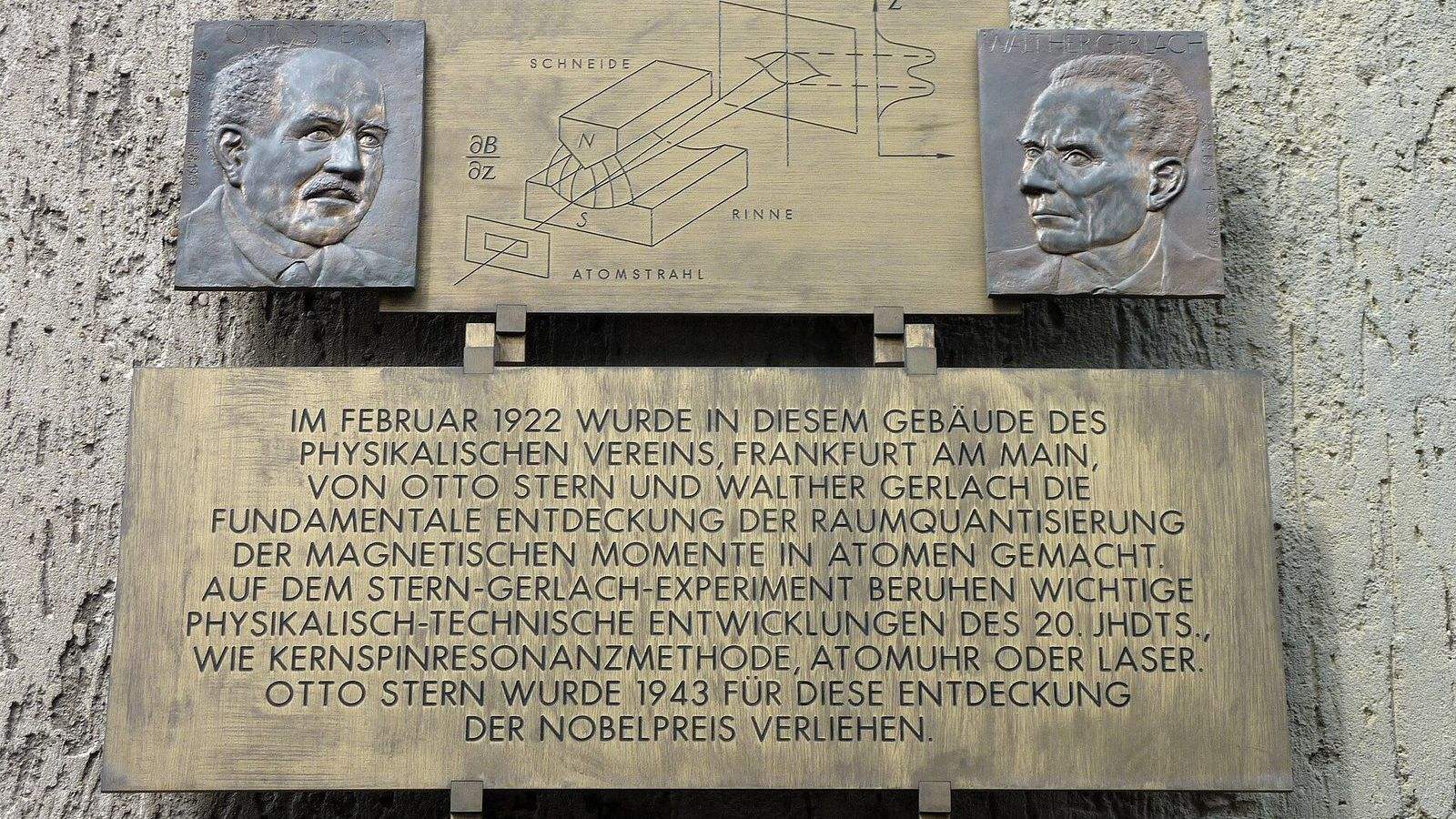
Here the classical picture of an arrow creeps back, with a precise meaning. The point on the Bloch sphere is the direction along which a measurement will give up with certainty. Measure along any other axis and the probability of up is \(\cos^2(\theta/2)\), where \(\theta\) is the angle between that axis and the arrow. At \(\theta = 90^\circ\) the probability is one half, which is what the Stern-Gerlach experiment shows when the second magnet is turned sideways. The arrow tells you the odds. It does not tell you a component.
The three operators that represent spin measurements along \(x\), \(y\), and \(z\) are two-by-two matrices, written down by Wolfgang Pauli in 1927. They do not commute, which is the mathematical statement that spin along \(x\) and spin along \(z\) cannot both be definite at once. Every two-level quantum system in physics, whatever it is made of, is described by the same three matrices, which is why the Bloch sphere of an electron and the Bloch sphere of a qubit are the same drawing.
Spin in a magnetic field
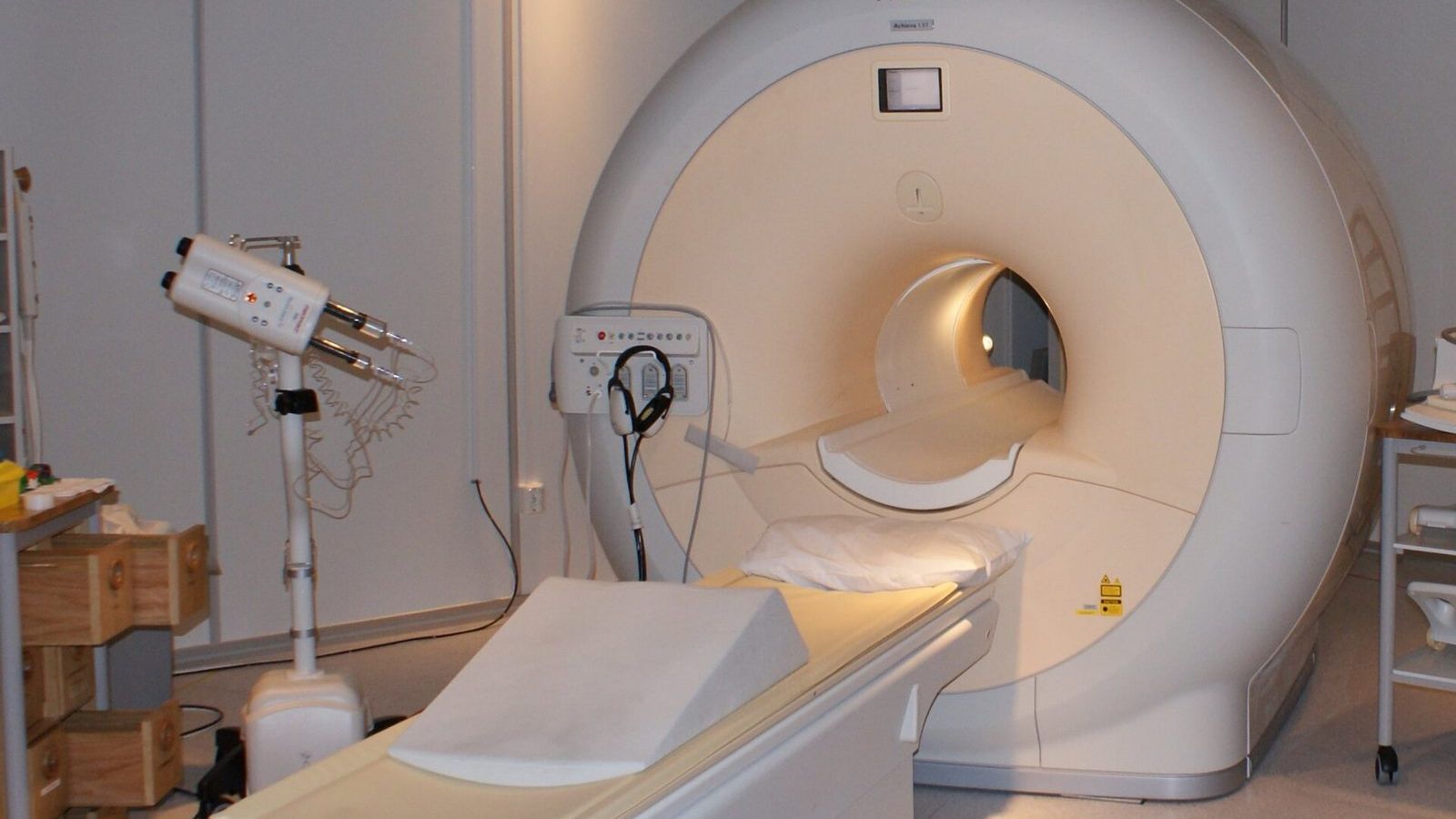
Place an electron in a magnetic field and the two spin states acquire different energies, with up along the field lower than down by an amount proportional to the field strength. The arrow on the Bloch sphere does not line up with the field; it precesses around it, like a tilted gyroscope around the vertical, at a frequency of 28 gigahertz per tesla for the electron. A proton, with its much smaller magnetic moment, precesses at 42.6 megahertz per tesla. These two frequencies are the basis of electron spin resonance and nuclear magnetic resonance, and the second is the frequency at which every MRI scanner in the world operates.
Where spin shows up
Spin is the reason the periodic table has the shape it has: each orbital holds two electrons because there are two spin states, and the exclusion principle allows one electron per state. Spin is the origin of magnetism. Iron is magnetic because the spins of some of its electrons line up over whole regions of the crystal, and the force that lines them up is electrostatic, acting through the exclusion principle, rather than magnetic. Every hard disk drive reads its data with a sensor based on the giant magnetoresistance of spin-polarized electrons, discovered in 1988 and rewarded with the Nobel Prize in Physics 2007. The caesium atomic clock that defines the second counts the oscillations of a transition between two states that differ in the relative orientation of the electron and nuclear spins. And the qubits of several quantum computers, in silicon, in diamond, and in trapped ions, are single spins.
Particles other than the electron have spin too. The proton and neutron have one half, the photon has one, the Higgs boson has zero, and some atomic nuclei have as much as seven. Particles with half-integer spin obey the exclusion principle and are called fermions; particles with integer spin do not and are called bosons, and the difference between the two kinds, which decides whether matter is rigid and whether a laser can work, is the subject of Unit 12 of the Quantum Mechanics Masterclass. Spin itself, with the Pauli matrices, the Bloch sphere, and the precession in a field, is built up in Unit 11, and the same two-level mathematics returns as the qubit in Unit 13.