 Image: NIST, Wikimedia Commons, public domain
The coldest things in the universe are in laboratories
The coldest natural place anyone knows is the Boomerang Nebula, a cloud of expanding gas five thousand light years away, at about one kelvin. Deep space itself sits at 2.7 kelvin, warmed by the afterglow of the big bang. Both are tropical compared with a few cubic millimetres of vacuum in a laboratory in Boulder, Colorado, where on 5 June 1995 a cloud of rubidium atoms was cooled to 170 nanokelvin, less than a millionth of a degree above absolute zero. At that temperature the atoms stopped behaving as a gas of separate particles and became one quantum object.
What was predicted
In 1924 the Indian physicist Satyendra Nath Bose sent Albert Einstein a short paper deriving Planck's radiation law by a new way of counting the states of light quanta. Einstein translated it, had it published, and applied the counting to atoms. He found that a gas of identical atoms of the kind that would later be called bosons, cooled below a certain temperature, would do something no classical gas does: a large fraction of the atoms would pile into the single lowest quantum state, all with the same wave function. The temperature at which this begins depends on the density of the gas and the mass of the atoms. For a gas as thin as the ones that can be trapped, it is below a microkelvin.
The reason is the de Broglie wavelength. An atom moving with thermal energy has a wavelength that grows as the temperature drops. At room temperature it is a hundredth of a nanometre, far smaller than the distance between atoms in a gas, and each atom is a separate particle. When the wavelength becomes as long as the spacing between the atoms, the waves overlap, the atoms lose their individuality, and the counting that Bose invented takes over. Condensation begins when the gas is cold enough and dense enough for this to happen, and for the clouds used in 1995 that meant a few hundred nanokelvin.
Cooling with light
No refrigerator gets anywhere near such temperatures. The first stage of the method uses laser light. An atom moving towards a laser beam tuned slightly below one of its absorption frequencies sees the light shifted up by the Doppler effect, into resonance, and absorbs photons; each photon gives it a small push backwards. An atom moving away sees the light shifted further off resonance and absorbs less. With six beams from six directions, every atom is pushed against whichever way it moves, and the cloud slows as if it were moving through treacle. The physicists who developed this called it optical molasses, and it brings the atoms from room temperature to about a hundred microkelvin in a fraction of a second. Steven Chu, Claude Cohen-Tannoudji, and William Phillips received the Nobel Prize in Physics 1997 for the method.
Laser cooling has a limit set by the random kicks of the emitted photons, and it stops a factor of a hundred to a thousand short of condensation. The last stage is older than physics: it is the way a cup of coffee cools. The atoms are held in a magnetic trap, and the trap's walls are lowered so that the fastest atoms escape. The ones that remain collide and share out the energy, and the average is lower than before. Repeating this for a few tens of seconds removes most of the atoms and leaves the rest a thousand times colder. Evaporative cooling, as it is called, is what took the Boulder cloud through the condensation temperature.
5 June 1995
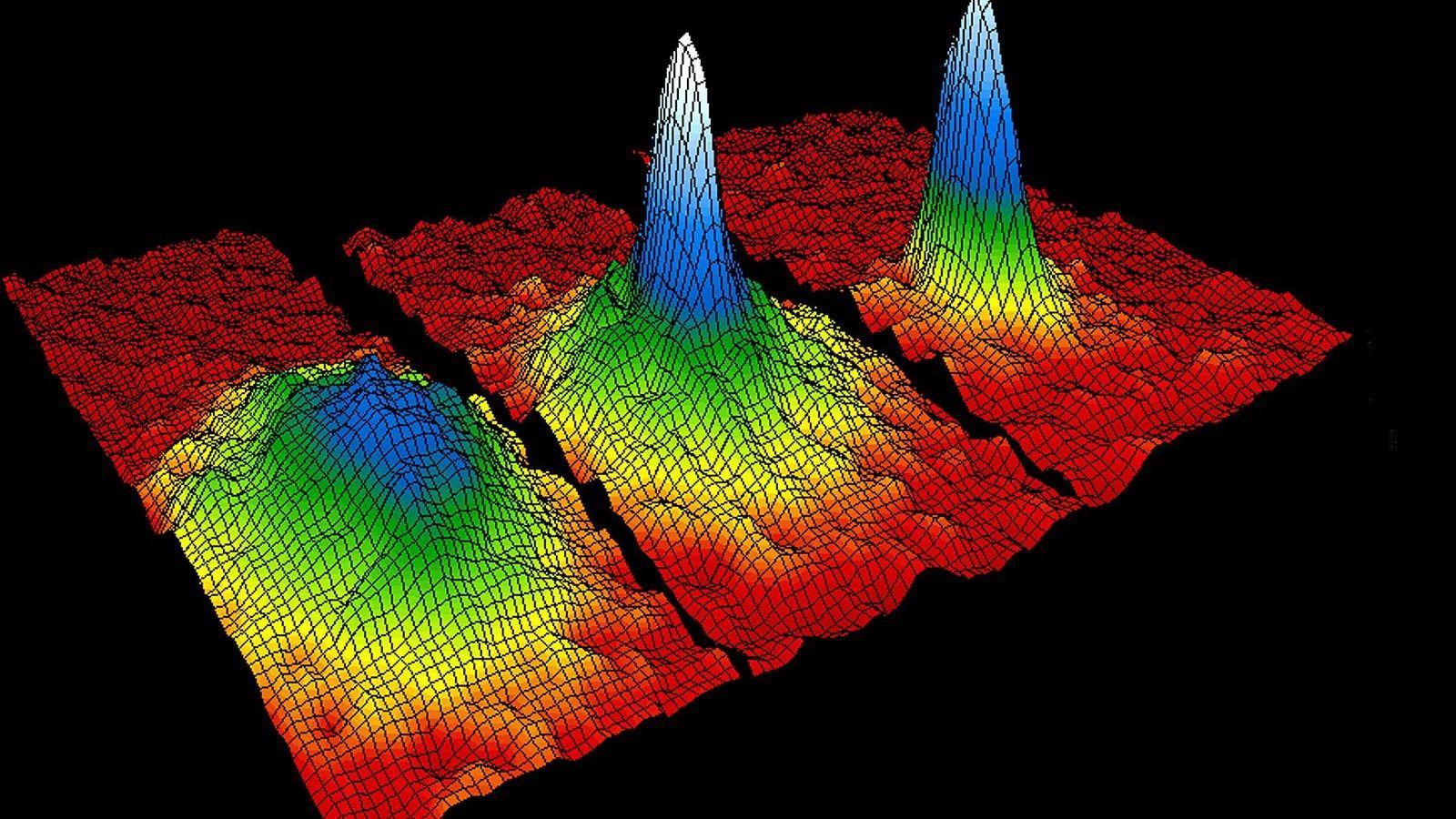
Eric Cornell and Carl Wieman, at JILA in Boulder, saw the first condensate in rubidium-87. Their paper in Science, retold in Cornell's Nobel lecture, shows three pictures of the cloud after the trap is switched off and the atoms have flown apart for a moment. Above the transition the velocity distribution is a broad, smooth hill, the ordinary thermal spread. Just below it a sharp peak rises out of the hill at zero velocity: the atoms in the condensate, all at rest in the same state. Colder still, the hill is gone and only the peak remains. About two thousand atoms were in the first condensate, at 170 nanokelvin. Four months later Wolfgang Ketterle's group at MIT condensed sodium with a hundred times more atoms, and the two groups shared the Nobel Prize in Physics 2001.
What a condensate is
A condensate is a cloud of atoms, typically a tenth of a millimetre across and visible on a camera, in which every atom has the same wave function. The whole cloud behaves as a single quantum wave. Split it in two and let the halves overlap, as Ketterle's group did in 1997, and they produce interference fringes, like the two beams of a double slit, except that the fringes are made of a hundred thousand atoms and can be photographed in one shot. Stir it and it does not swirl like water; it forms a lattice of tiny quantized whirlpools, each carrying exactly one unit of angular momentum. Shine a light pulse into it under the right conditions, as Lene Hau's group at Harvard did in 1999, and the pulse slows to 17 metres per second, bicycle speed, and can be stopped and stored in the atoms altogether.
Condensates are made of bosons, atoms whose total spin is a whole number. Atoms with half-integer spin, fermions, refuse to share a state, and a gas of them cooled to the same temperatures does something different: the atoms stack up one per state like electrons in a metal, and if they attract each other weakly they can pair up, as the electrons in a superconductor do. Deborah Jin's group at JILA made the first such fermionic condensate in 2003.
Colder still
The record has fallen since 1995. Clouds at a few hundred picokelvin, a thousand times colder than the first condensate, were made by releasing atoms in free fall and letting them expand slowly; one experiment, dropped 110 metres down the drop tower in Bremen, reached 38 picokelvin in 2021. Since 2018 a condensate machine has operated on the International Space Station, where the absence of gravity lets the clouds expand for seconds instead of milliseconds. The practical uses are precision instruments: atom interferometers that measure gravity well enough to find tunnels and mineral deposits, atomic clocks that would lose a second in thirty billion years, and simulators in which cold atoms in a lattice of laser light stand in for the electrons of a solid that no computer can model.
In the Quantum Mechanics Masterclass the Bose-Einstein condensate is the final topic of Unit 12, which derives the difference between bosons and fermions from the symmetry of the wave function and computes the condensation temperature from the de Broglie wavelength. The research of Ketterle and Hau on these clouds is presented in the same unit. The de Broglie wavelength itself, and why it grows when atoms slow down, is the subject of Unit 3.