What a photon is and what it is not
When students ask What a photon is and what it is not, the shortest honest answer is that a photon is the quantum of light, and light does not come in any smaller classical pieces. A photon has energy, momentum, and a well defined frequency or wavelength when it is in a simple state, but it is not a tiny coloured bead flying through space. The formulas \\(E = hf\\) and \\(p = h/\lambda\\) tell us exactly how much energy and momentum one photon carries, and the photoelectric effect shows why that picture is necessary.
What a photon is and what it is not
A photon is the smallest packet in which electromagnetic radiation is exchanged. If a beam of light has frequency \\(f\\), then one photon in that beam has energy
\[E = hf\]
where \\(h = 6.62607015 \times 10^{-34}\\,\mathrm{J\,s}\\) is the Planck constant, exact by definition in the SI system. For green light, take a wavelength of about \\(550\\,\mathrm{nm}\\). Using \\(f = c/\lambda\\), with \\(c = 2.99792458 \times 10^8\\,\mathrm{m/s}\\), the frequency is about \\(5.45 \times 10^{14}\\,\mathrm{Hz}\\). One photon then has energy
\[E \approx (6.626 \times 10^{-34})(5.45 \times 10^{14}) \approx 3.61 \times 10^{-19}\\,\mathrm{J} \approx 2.25\\,\mathrm{eV}.\]
The same photon has momentum
\[p = \frac{h}{\lambda} \approx \frac{6.626 \times 10^{-34}}{5.50 \times 10^{-7}} \approx 1.20 \times 10^{-27}\\,\mathrm{kg\,m/s}.\]
These numbers are small, but they are measurable. They also show why a photon is a very different object from a small ball. A ball can sit still and have any energy you like if you move it fast enough. A photon always moves at the speed of light in vacuum, always carries momentum, and in free space has zero rest mass. Its behaviour is quantum, so the classical image of a hard particle with a definite path only works as a rough approximation in some experiments.
The photoelectric effect and why light is quantized
The clearest early evidence for light quanta came from the photoelectric effect. If light shines on a metal surface, electrons can be ejected. Classical wave theory expected the electron energy to depend mainly on brightness. The experiments showed something else. There is a threshold frequency for each metal, and above that threshold the electron energy rises with frequency, not with intensity.
Einstein explained this in 1905 by treating light as packets of energy, each packet carrying \\(hf\\). One photon can transfer all its energy to one electron. If the photon energy is larger than the metal’s work function, an electron can escape. If it is smaller, no amount of waiting helps, no matter how bright the light is. That is why red light, with lower frequency than green light, can fail to eject electrons from some metals while ultraviolet light succeeds.
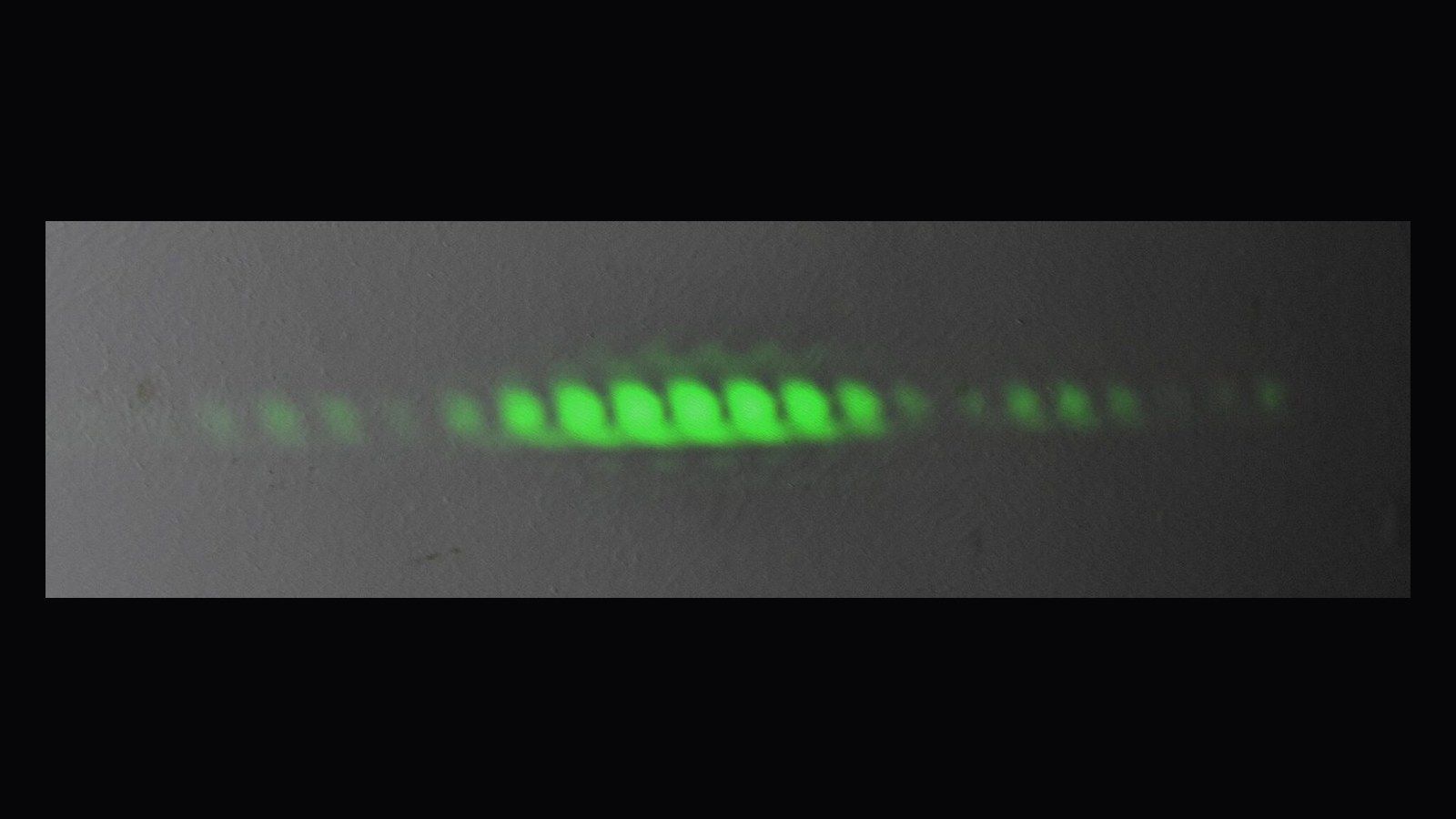
The photoelectric effect does not mean that light is made of tiny billiard balls. It means that the exchange of energy happens in discrete amounts. Light still shows interference and diffraction, and a single photon can produce an interference pattern when many events are accumulated one by one.
For a student-friendly introduction to the wave side of this story, see the double-slit experiment with one electron at a time. For the broader setting of light quanta, the best match in the masterclass is The Quantum of Light.
How one photon can be counted today
Modern experiments do count single photons. A detector does not usually register a photon by seeing a tiny object hit a sensor. It registers an electrical pulse after a quantum event in the detector material. In a photomultiplier tube, one photon can release one photoelectron, and that electron can start an avalanche of more electrons. In an avalanche photodiode, a single absorbed photon can trigger a similar cascade. In a superconducting nanowire single-photon detector, a photon absorbed by an ultrathin superconducting strip creates a local resistive region, and the resulting voltage pulse is read out electronically.
These devices are used in quantum optics, fibre-optic communication tests, astronomy, and metrology. They are sensitive enough that detector noise, dark counts, and timing jitter matter. In other words, single-photon counting is a real laboratory technique, and it depends on a careful quantum description of light and matter.
For a related view of how light interacts with atoms, read Where the hydrogen lines come from. If you want to see where this topic sits among the course units, browse the Quantum of Light unit and the wider Complex Numbers, Waves, and Probability unit.
What a photon can and cannot be in a model
It is useful to think of a photon as a quantum object with particle-like detection events and wave-like propagation. That sentence is less tidy than a picture of a tiny sphere, but it is closer to experiment. A photon can be created, absorbed, reflected, split in amplitude, and counted. It cannot be assigned the same sort of trajectory a marble has on a table.
In vacuum, a free photon has energy \\(E = hf\\), momentum \\(p = h/\lambda\\), and no rest frame. In a material medium, the simple vacuum formulas need care because light and matter are interacting. Even so, the photon remains the standard quantum of the electromagnetic field, and the field description is what makes the theory work across optics, spectroscopy, and modern quantum technologies.
If you want another article that keeps the distinction between a classical picture and a quantum one clear, try What a qubit is.
Reliable sources for the numbers and the experimental picture include the NIST values of the fundamental physical constants, the Nobel Prize page for Einstein and the photoelectric effect, and the Science article on superconducting nanowire single-photon detectors. For a broader review of detectors, see the IOP review on single-photon detectors.
Frequently asked questions
Is a photon a particle or a wave?
It behaves like both, depending on the experiment. The safest description is that a photon is a quantum of the electromagnetic field.
Does a brighter beam mean each photon has more energy?
No. Brightness usually means more photons per second. The energy of each photon depends on frequency, so blue or green photons carry more energy than red photons.
Can a single photon be measured directly?
Yes. Single-photon detectors turn one absorbed photon into an electrical pulse, which is then counted.